Station
Soil is a Living Community
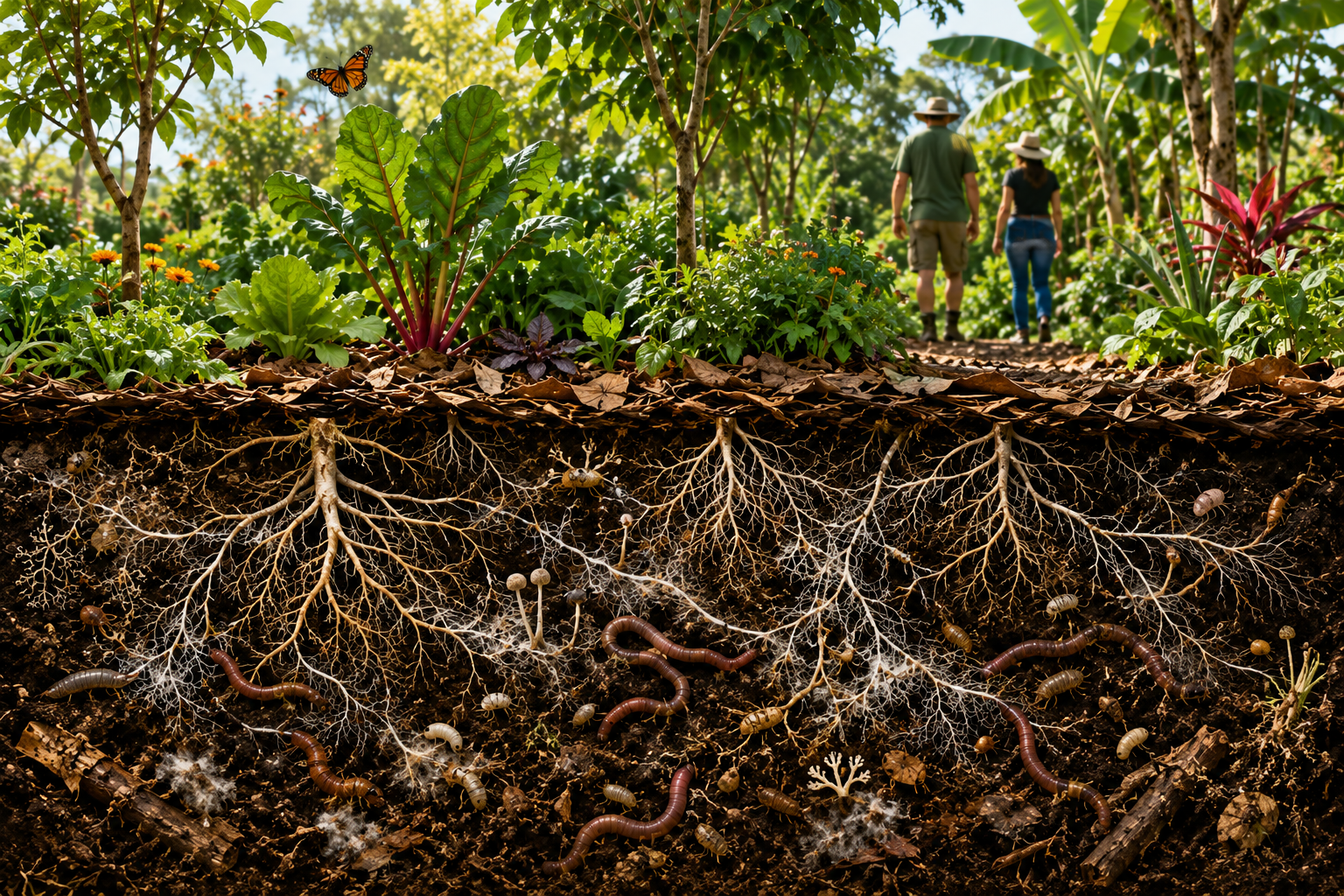
Agroecology views soil as a living community rather than an inert growing medium.
Beneath the surface exists an extraordinary diversity of life. Plant roots, fungi, bacteria, earthworms, insects and countless microscopic organisms interact continuously. Together they contribute to nutrient cycling, soil structure, water retention and the health of plants growing above ground.
In natural ecosystems, soil life helps transform fallen leaves, dead roots and organic matter into fertility. Nutrients are recycled through complex biological processes and become available to new generations of plants. Healthy soils are continually renewed through the activity of living organisms.
Agroecology works with these processes rather than attempting to replace them. Practices such as mulching, biomass recycling, reduced soil disturbance, diverse planting and continuous ground cover help create conditions that support soil life and ecological function.
At Ediblescapes, soil is cared for as a living system. Prunings and plant material are returned to the garden as mulch. Fallen leaves are allowed to decompose. Roots remain in the soil after harvest. Diverse plants contribute different forms of organic matter and support a wide range of organisms beneath the surface.
Many of these processes are invisible to visitors, yet they play a vital role in the productivity and resilience of the garden. The food harvested above ground depends upon countless relationships occurring below ground.
Agroecology recognises that healthy food systems begin with healthy soils. By supporting the diversity and activity of soil organisms, gardens can become more fertile, resilient and capable of regenerating themselves over time.
As you walk through Ediblescapes, consider the hidden world beneath your feet. Every step passes over a living community whose work helps sustain the garden and the many forms of life that depend upon it.
A question to consider
Who might be living beneath your feet, and how do they help this garden grow?
Continue the trail
Explore all stations ▼
Read this place through another lens
Ediblescapes can be explored through many interconnected ways of reading the garden — including permaculture, syntropic practice, living biology, biocultural food knowledge, agroecology, and commons-based community care.