Station
Diversity Creates Resilience
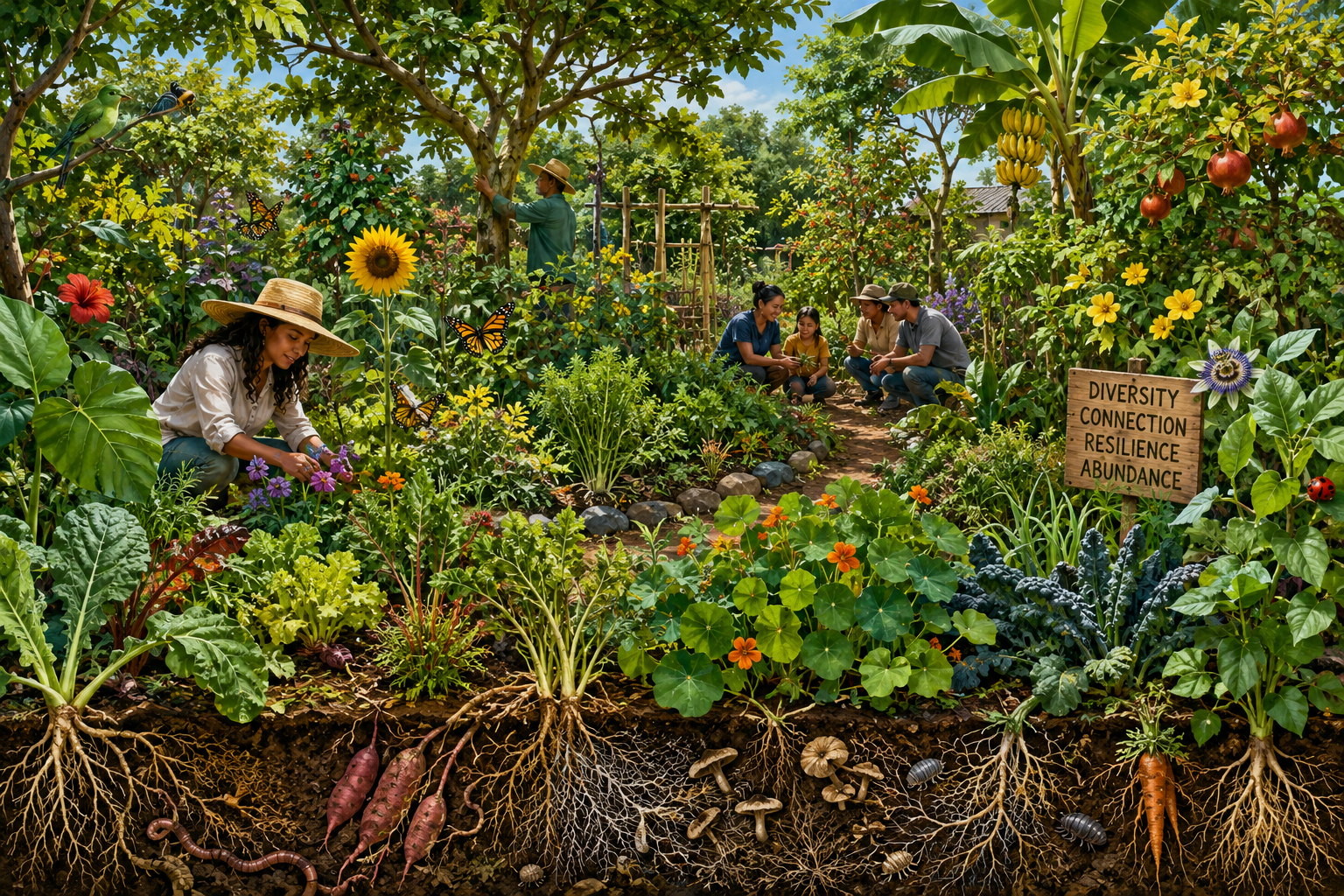
Agroecology recognises diversity as one of the foundations of healthy food systems.
Natural ecosystems are rarely dominated by a single species. Instead, many organisms live together, performing different functions and creating countless relationships. Some plants capture sunlight high in the canopy. Others grow beneath them in partial shade. Some build soil fertility, attract pollinators or provide habitat for beneficial insects. Beneath the surface, roots, fungi, microorganisms and soil animals contribute to the continual renewal of life.
Agroecology learns from these ecological patterns. Rather than simplifying landscapes into monocultures, it encourages diversity across species, functions and scales. Diverse systems are often better able to adapt to changing conditions because different organisms respond differently to drought, heavy rainfall, pests, disease and disturbance.
At Ediblescapes, diversity can be observed throughout the garden. Trees, shrubs, vines, groundcovers, root crops and edible leafy plants grow alongside one another. Perennial and seasonal species contribute to a continuously changing landscape of food, habitat and ecological activity. Flowering plants attract pollinators and other beneficial organisms. Biomass from one part of the garden becomes fertility for another.
Agroecology also recognises forms of diversity beyond ecology. Diverse foods contribute to healthier diets. Diverse cultural traditions enrich food knowledge. Diverse experiences and perspectives strengthen community learning. A resilient food system depends not only on biological diversity, but also on the diversity of people, skills and knowledge that participate within it.
At Ediblescapes, plants from many regions of the world grow together. Community members bring different experiences, cultural food traditions and practical knowledge. These ecological and cultural forms of diversity continually interact, creating opportunities for learning, adaptation and regeneration.
As you explore the garden, look beyond individual plants. Notice the variety of species, colours, textures, heights, flowers, insects, foods and people that contribute to this living system. Diversity is not simply a collection of different things. It is the living foundation from which resilience emerges.
A question to consider
What kinds of diversity can you find around you, and how might they contribute to the health of this place?
Continue the trail
Explore all stations ▼
Read this place through another lens
Ediblescapes can be explored through many interconnected ways of reading the garden — including permaculture, syntropic practice, living biology, biocultural food knowledge, agroecology, and commons-based community care.