Station
Sharing the Harvest
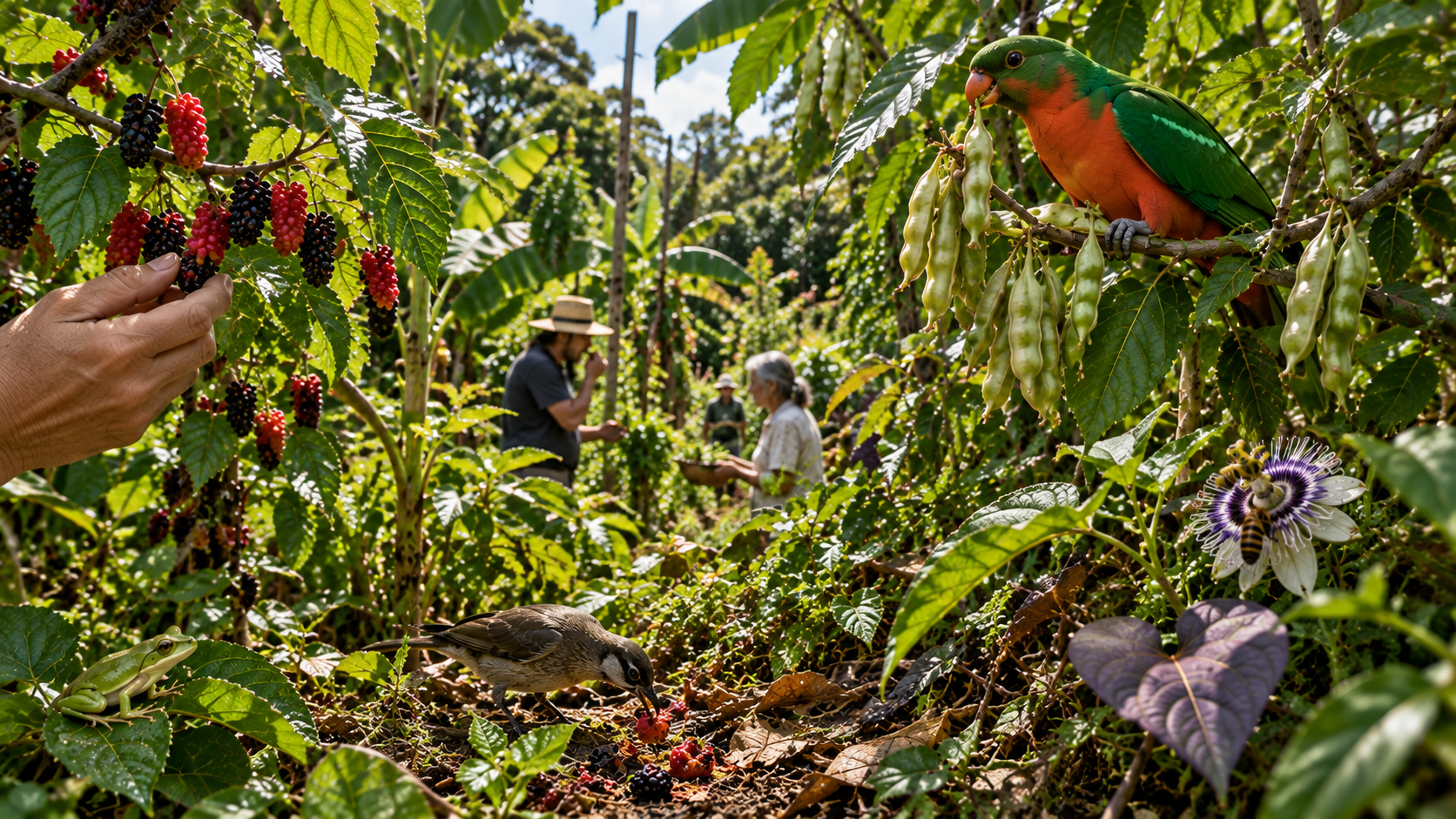
Harvest can seem like a simple relationship: a person grows food and then picks it.
Look again.
A King Parrot opens a pigeon pea pod. A person reaches for a ripe mulberry. An insect visits a flower. Another bird discovers fallen fruit. What remains eventually meets soil organisms and decomposition. Different lives encounter the garden's abundance in different ways.
This does not mean that everything must always be available to everyone, or that caring for food plants requires no boundaries. Sometimes fruit is protected, plants are contained, particular foods are harvested at particular times, and people negotiate how much to take and what to leave.
A commons-based garden therefore invites a richer question than simply “Can I harvest this?”
It asks us to notice the relationships surrounding the harvest: maturity, abundance, restraint, access, cultural practice, care and the needs of other living beings.
In a sufficiently abundant living garden, harvesting can become more than taking food from a place. It can become participation in a food landscape already being shared.
A question to consider
Who else is eating here?
Continue the trail
Explore all stations ▼
Read this place through another lens
Ediblescapes can be explored through many interconnected ways of reading the garden — including permaculture, syntropic practice, living biology, biocultural food knowledge, agroecology, and commons-based community care.