Station
Crossing Boundaries
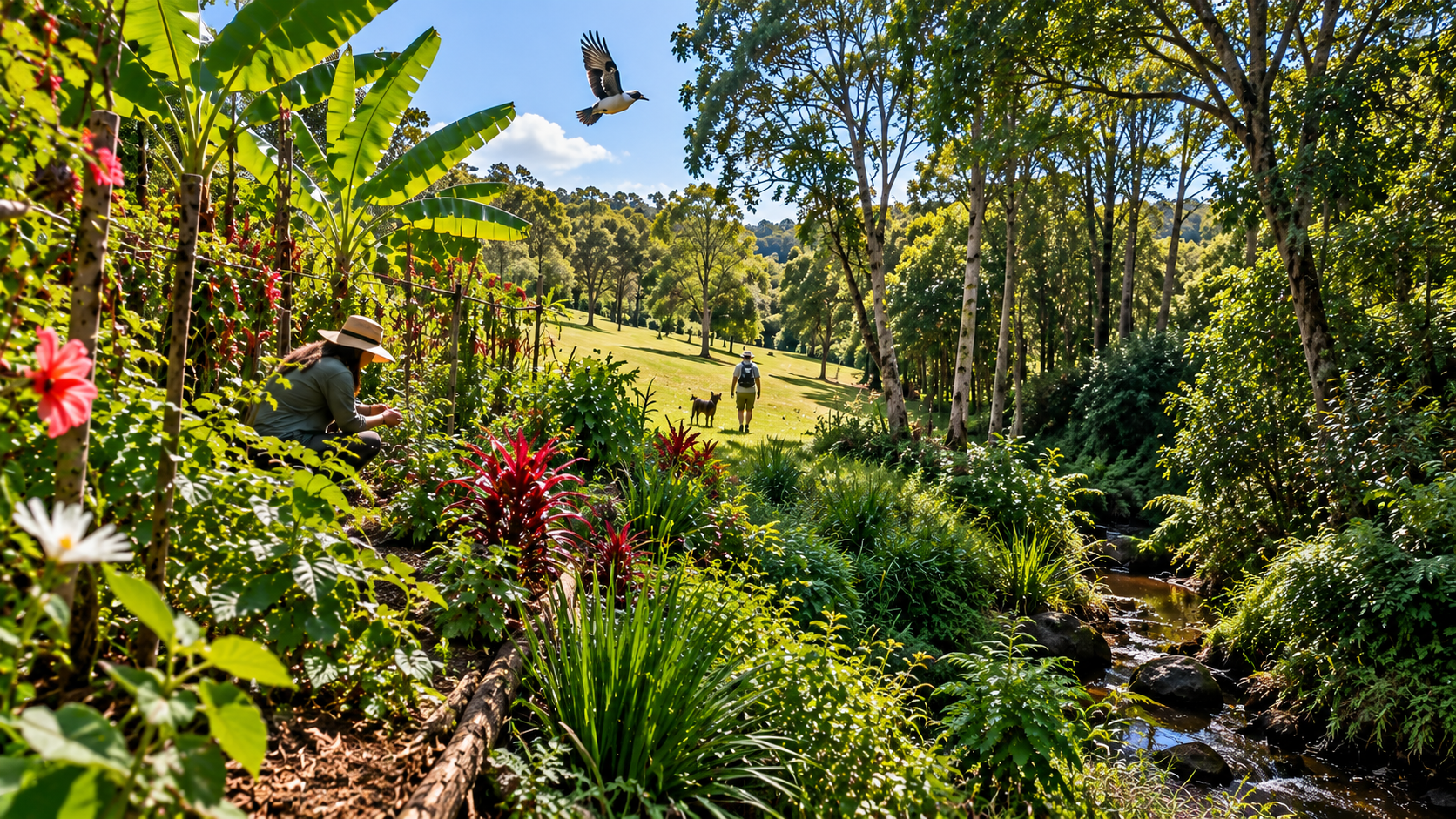
Every garden has boundaries of some kind. They may mark land, responsibility, pathways, management or different ways of caring for a place.
But living relationships rarely stop exactly at those lines.
Birds fly between trees. Water moves through soil and across surfaces. Seeds travel. Roots extend beyond what we can see. People arrive carrying memories and knowledge, and leave carrying new questions, stories or practices.
The garden therefore has more than one kind of edge.
A boundary may tell us where responsibility changes without completely telling us where relationship ends.
In a commons-based community garden, boundaries can still matter. They can help clarify care, responsibility, access and stewardship. The invitation is not to pretend that boundaries disappear, but to notice what continually moves through them.
Perhaps the living garden extends, in different ways, wherever its relationships continue.
A question to consider
What crosses this boundary?
Continue the trail
Explore all stations ▼
Read this place through another lens
Ediblescapes can be explored through many interconnected ways of reading the garden — including permaculture, syntropic practice, living biology, biocultural food knowledge, agroecology, and commons-based community care.