Station
The Living Soil Beneath Your Feet
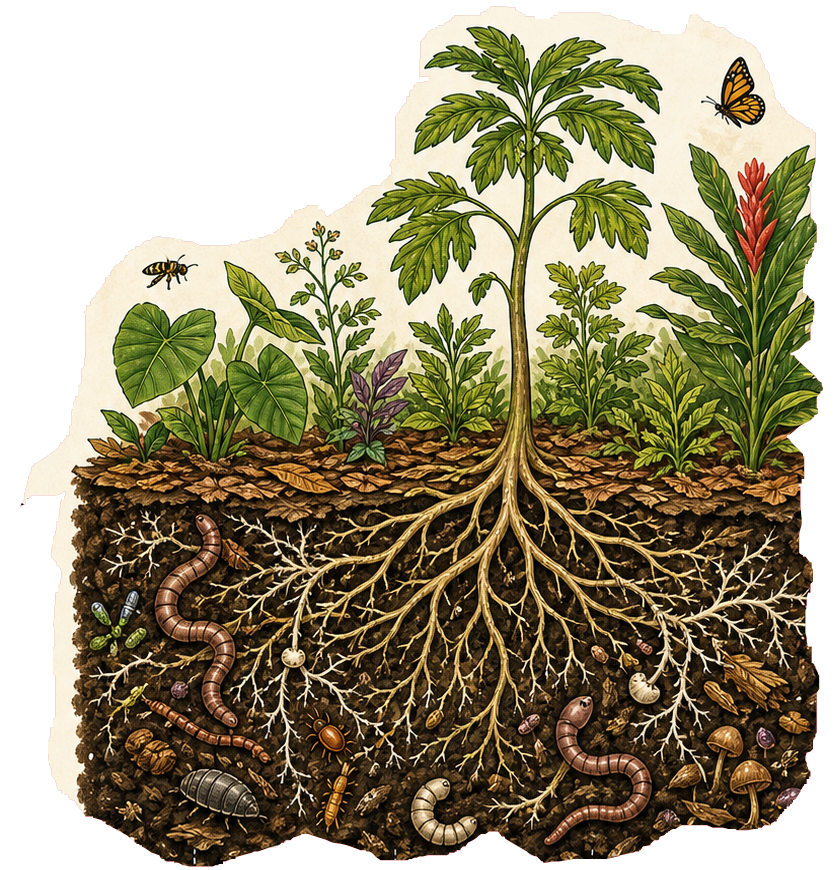
Reading the living processes beneath and around us
Much of the life that sustains this garden cannot be seen from above ground.
Beneath our feet exists a living underground ecosystem made of roots, fungi, bacteria, insects, worms, moisture, minerals, and decomposing organic matter. These relationships continuously recycle nutrients, store water, build soil structure, and support plant health.
Healthy soil is not simply “dirt.”
It is a living biological community.
In natural ecosystems, fallen leaves, branches, roots, and dead organisms gradually decompose and become food for countless microorganisms and soil organisms. Over time, this process creates fertile, moisture-retaining soil capable of supporting increasingly diverse plant and animal life.
At Ediblescapes, practices such as mulching, pruning, composting, dense planting, and leaving organic matter on the ground help feed this underground ecosystem. The garden is not only growing plants above the surface — it is also cultivating life below it.
The living soil becomes the foundation of the edible forest.
This station invites visitors to observe the ground differently — not as an inert surface, but as a dynamic and living process constantly transforming energy and matter into new life.
A question to consider
If the soil is alive, how do we care for it?
Continue the trail
Explore all stations ▼
Read this place through another lens
Ediblescapes can be explored through many interconnected ways of reading the garden — including permaculture, syntropic practice, living biology, biocultural food knowledge, agroecology, and commons-based community care.