Station
Life Never Stops Recycling
About This Station
Look at the ground beneath the trees.
Fallen leaves, flowers, twigs and fruit may seem like the end of a life cycle, but in a living garden they are the beginning of renewal.
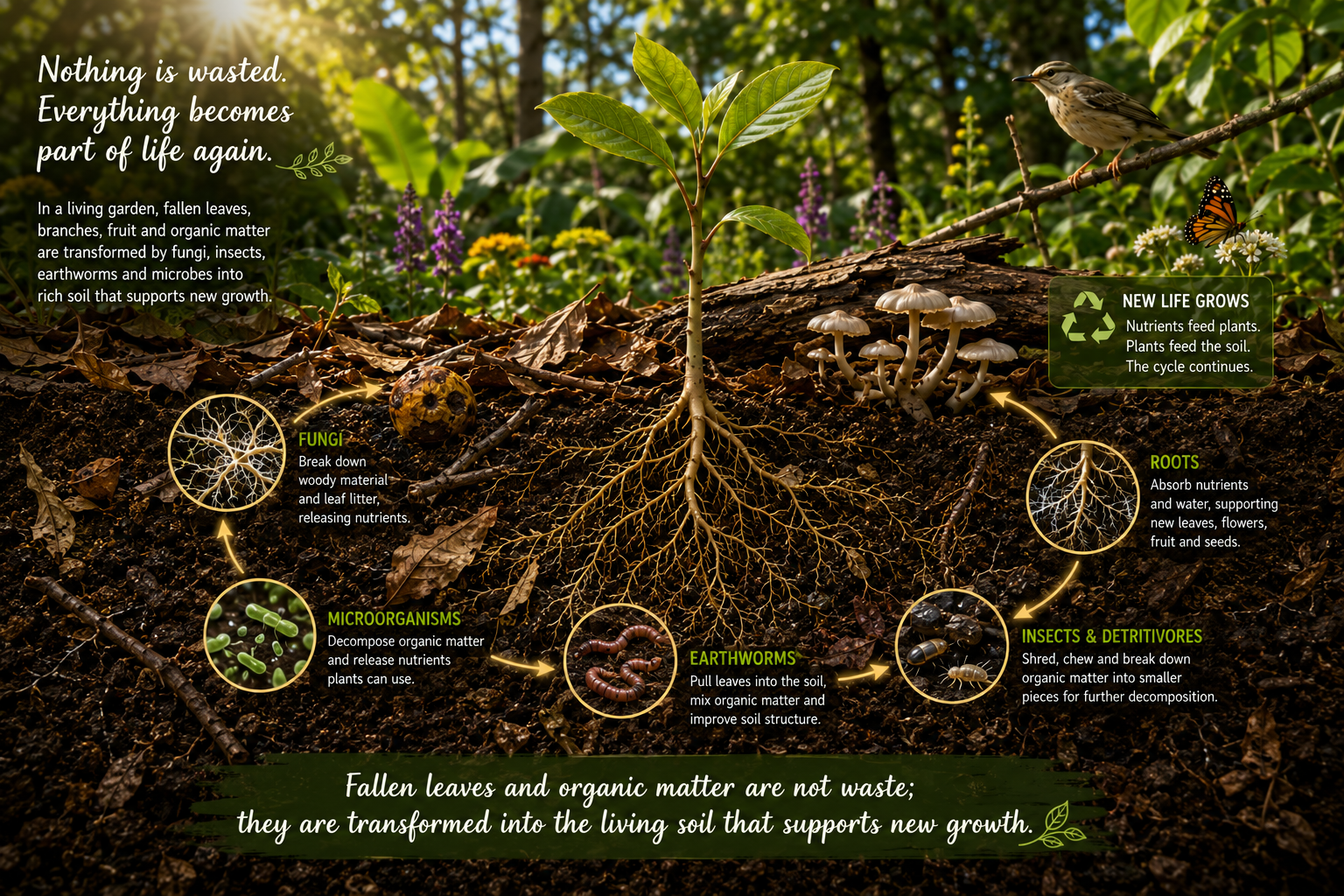
Fungi, bacteria, insects, earthworms and many other soil organisms break down organic matter and return nutrients to the soil. As this material becomes humus, it helps the soil hold water, feed roots and create fertile conditions for new growth.
The edible forest garden depends on this continuous transformation.
Leaves become mulch.
Mulch becomes soil.
Soil feeds roots.
Roots grow new leaves.
Nothing moves in a straight line. Life moves in cycles.
When we understand this process, we begin to see fallen leaves differently. They are not rubbish. They are tomorrow’s fertility, food and forest.
In the living garden, nothing is ever truly lost.
A question to consider
What signs of renewal can you find where old leaves, branches or fruit are returning to the soil?
Continue the trail
Explore all stations ▼
Read this place through another lens
Ediblescapes can be explored through many interconnected ways of reading the garden — including permaculture, syntropic practice, living biology, biocultural food knowledge, agroecology, and commons-based community care.