Station
Everything is Connected
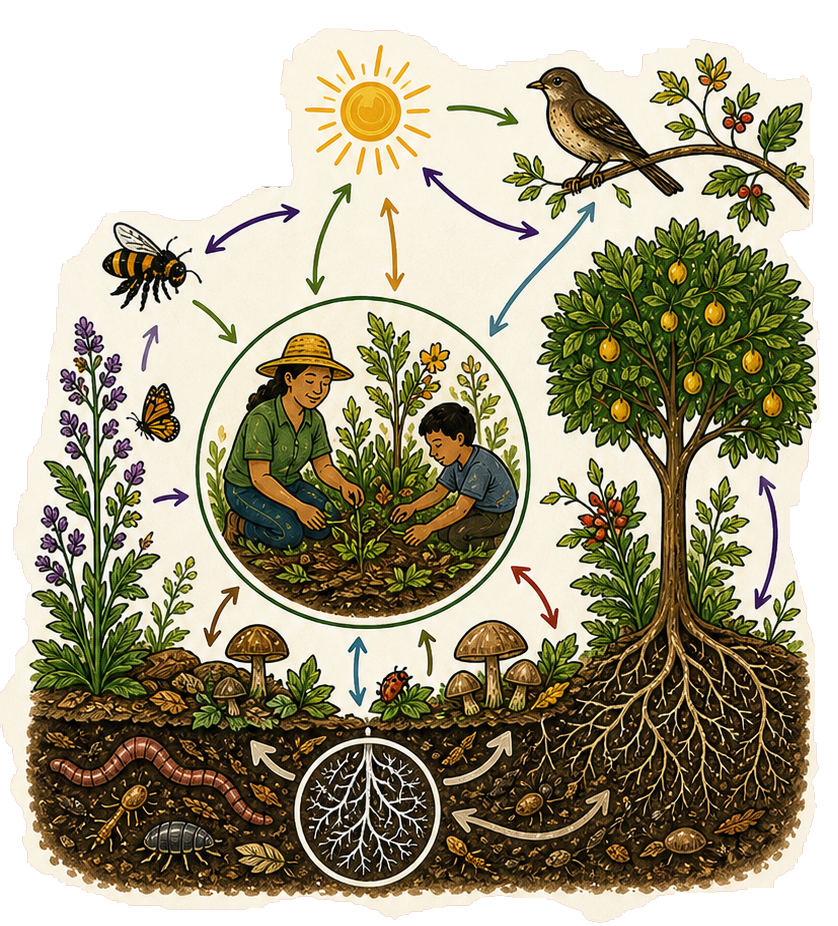
Reading the living relationships of the garden
Nothing in this garden exists in isolation.
Plants interact with fungi beneath the soil. Flowers attract pollinators. Birds disperse seeds. Insects recycle organic matter. Shade influences moisture. Humans prune, harvest, plant, observe, and care for the evolving system.
Together, these interactions form a living ecological network.
The health of the edible forest depends not only on individual species, but on the quality and diversity of relationships between living organisms and their environment. Greater biodiversity often creates greater resilience, allowing ecosystems to adapt more effectively to changing conditions.
Agroecology and syntropic practices work with these living relationships rather than against them. Instead of simplifying ecosystems into isolated crops or monocultures, diverse plantings help generate beneficial interactions between species, layers, microorganisms, insects, animals, climate, and soil life.
At Ediblescapes, the garden is continuously changing through these connections. Pruning creates mulch. Mulch feeds soil organisms. Soil organisms support plants. Flowers attract pollinators. People harvest food and return organic matter back into the system.
Life supports life through relationship.
This station invites visitors to observe not only individual plants or organisms, but also the invisible connections that link them together into one living system.
A question to consider
What relationships can you see around you right now?
Continue the trail
Explore all stations ▼
Read this place through another lens
Ediblescapes can be explored through many interconnected ways of reading the garden — including permaculture, syntropic practice, living biology, biocultural food knowledge, agroecology, and commons-based community care.