September 2026
September brought contrasting weather and limited rainfall to the 90 m² garden, prompting weekly supplementary watering across its interconnected growing areas. Volunteer vegetation showed a new growth pulse following earlier cut-and-drop interventions, while young trees continued establishing from propagated cuttings. Birds feeding on bananas and deer browsing tender plants revealed the garden's shared relationship with wildlife. Through observation rather than intensive intervention, the month raised deeper questions about living soil, water, syntropic regeneration and the ecological relationships that extend beyond human food production.
September 2026 — Reading the Living Garden Through Seasonal Change
September brought a changing combination of warm, dry days, cooler conditions and occasional rain to Ediblescapes Garden – Country Paradise Parklands, Nerang. Without a significant rainfall event sufficient to meet the garden's perceived moisture needs, supplementary watering became a weekly activity in the 90 m² observation area.
Yet the month's story is not primarily about irrigation. It is about observing how an interconnected garden responds to seasonal change, earlier vegetation management and the relationships among its plants, soil, water and wildlife.
Volunteer vegetation cut during late July and early August had returned in a new pulse of growth, with some plants reaching approximately 40 cm and beginning to flower. Young trees propagated from earlier selective pruning of border vegetation continued establishing in the central cropping beds. Birds feeding on a banana bunch prompted a reconsideration of harvesting for human use.
No pruning or mulching was undertaken within the 90 m² area during September. The garden was largely observed as it developed, with supplementary watering and one banana harvest being the recorded interventions.
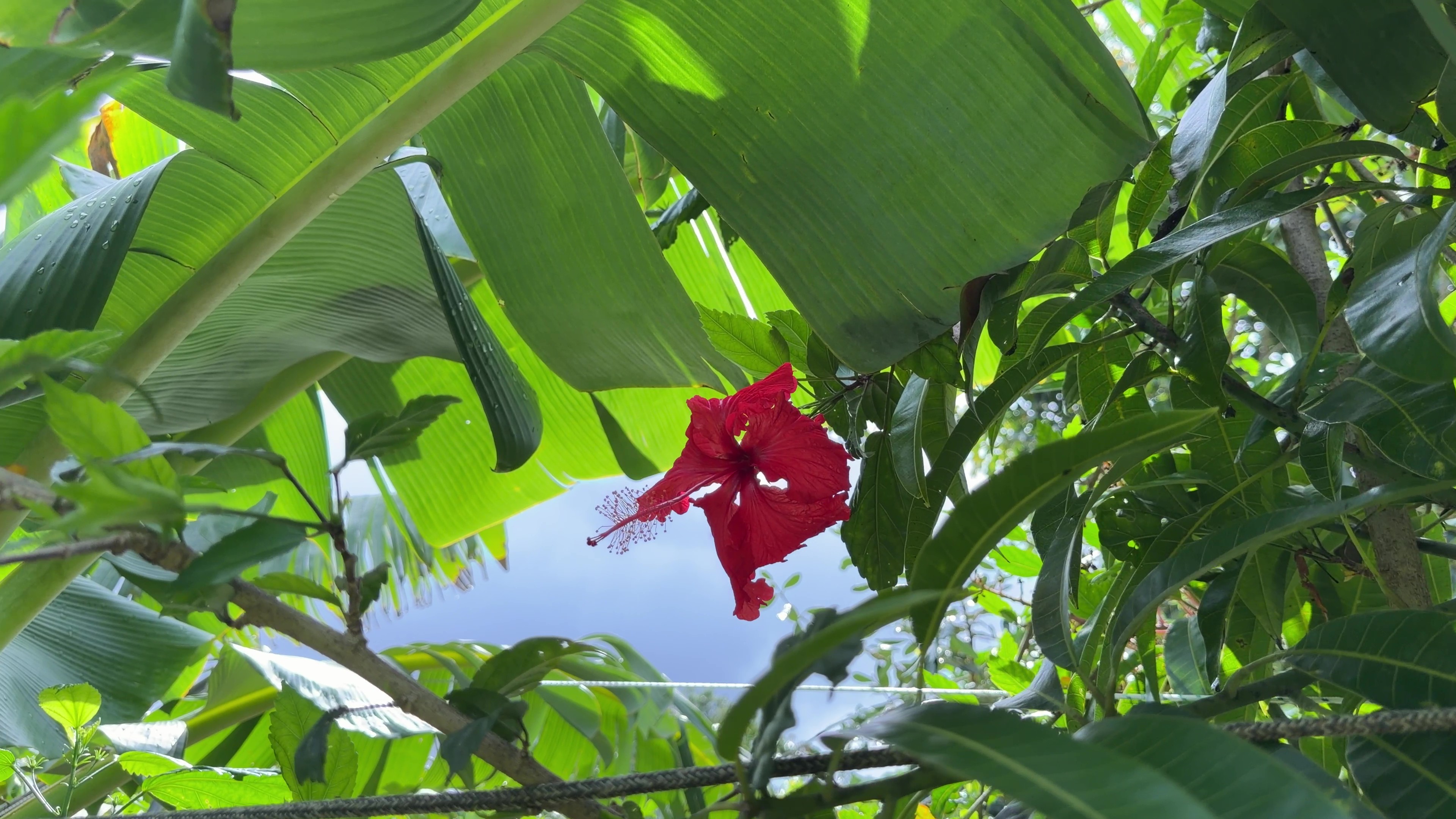
Deer were also visiting the garden, browsing tender woody growth — particularly hibiscus — and occasionally uprooting young plants whose roots were not yet firmly established.
Key observation: The garden's development cannot be understood through plant growth or harvest quantities alone. Its living relationships extend across vegetation layers, roots, soil organisms, decomposing organic matter, water and wildlife — including processes that remain largely invisible from the surface.
Between Winter and Summer
September was marked by contrasting weather conditions. Warm, dry days alternated with cooler periods and occasional rain, giving the impression of winter and summer arriving within the same week.
The absence of significant rainfall prompted closer attention to the garden's moisture conditions as spring growth developed.
Surface soil conditions, however, do not necessarily reveal the moisture available deeper in the root zone. The garden's developing vegetation cover, roots, organic matter and biological activity may influence how water infiltrates, moves and remains available.
These relationships are part of the ongoing observation rather than conclusions already established by measurement.
Watering an Interconnected Living System
During September, the 90 m² garden received supplementary watering every week, alternating between its central cropping beds and its northern and southern borders.
In the first and third weeks, watering concentrated on the central cropping beds, where young trees propagated from cuttings were establishing. In the second and fourth weeks, watering shifted to the border beds, where established trees and perennial vegetation were growing.
Each occasion lasted approximately two to three hours.
Water was supplied through a movable 30 m perforated spray hose, connected to the Parklands water supply through the garden's longer hose network. Two additional spray hoses operated simultaneously in other areas of Ediblescapes Garden.
Why water the borders when the youngest propagated trees are in the central beds?
Because the garden is understood as one interconnected living ecosystem, rather than separate groups of plants requiring isolated treatment.
The central beds, perennial borders and pathways — including places where organic material decomposes in situ — all contribute to the soil environment. Roots extend beyond visible planting positions, while microorganisms, soil fauna, organic matter and moisture participate in biological processes throughout the garden.
Watering the borders was therefore intended to support suitable moisture conditions across different parts of this living environment, not merely to prevent visible wilting in individual plants.
This does not mean that water, organisms or nutrients move uniformly throughout the garden. Understanding those movements remains an important subject for further observation and investigation.
Understanding Water Use — Beyond the Hose
The September watering pattern also invites a practical community-learning exercise.
Ediblescapes Garden does not use a permanent automated drip irrigation system for this observation area. The movable spray hose is positioned according to the garden's conditions and the intended area of watering.
Four watering occasions of approximately two to three hours represent an estimated eight to twelve hours of operation for the hose serving the 90 m² area.
The actual volume of water supplied was not measured.
For educational purposes, we can explore a hypothetical calculation. If the spray hose discharged two litres per minute and operated for an average of two and a half hours on each of four occasions, the estimated volume would be 1,200 litres.
This figure is an illustration, not a measurement of September's water consumption. Actual discharge depends on water pressure, hose resistance, the number and size of perforations, and the operation of the wider distribution system.
More importantly, knowing the volume entering the garden would still provide only a partial understanding of water use.
What proportion infiltrates the soil? How does moisture vary with depth? How do roots, soil structure, organic matter and living organisms influence its movement and retention? How do shade, vegetation density and seasonal conditions affect evaporation and plant water demand?
A water meter could help answer how much water was supplied. Understanding what happens after the water reaches the soil requires a broader ecological investigation.
This is an opportunity for community agroecological education: beginning with observations and transparent calculations, recognising what remains unknown, and gradually developing better ways to investigate the living garden.
A New Pulse of Volunteer Vegetation
During September, volunteer vegetation cut during late July and early August showed a renewed pulse of growth.
Among the plants observed were volunteer potato plants and vegetation locally described as chicken weed or pigweed. Some had grown to approximately 40 cm and were beginning to flower.
The earlier cutting was selective. Rather than uprooting the vegetation, the practice retained below-ground plant structures and left cut biomass within the garden.
The new growth can be read through the syntropic concept of a growth pulse: the renewed development of vegetation following an intervention in the garden's growth cycle.
However, the observed response may have several contributing causes, including regrowth from surviving plant structures, germination, seasonal warming, changing light conditions and soil moisture.
The vegetation now presents another possible management decision.
Some plants may require selective cutting before seeds become viable and disperse. Dense growth may also reduce the sunlight reaching young trees. While these young trees benefit from some protection against intense sunlight, they still require sufficient light for healthy development.
A future cut-and-drop intervention may therefore be appropriate, depending on what is observed.
The intention is not to eliminate spontaneous vegetation, but to work with its changing functions — groundcover, biomass production, shade, regeneration and competition — through careful timing and selective intervention.
Tree Pruning, Propagation and Syntropic Growth
The garden's border trees and perennials provide another connection to syntropic practice.
During earlier management interventions, some border vegetation received selective pruning. These were not deep rejuvenation cuts. Suitable branches from that pruning were used as propagation material, producing young trees now establishing in the central cropping beds.
This creates a visible relationship between the established border vegetation and the next generation of plants.
In Ernst Götsch's syntropic approach, strategic pruning — particularly of trees — is understood as a way to influence the growth dynamics and succession of a plant community. Pruning can regulate light, stimulate regrowth, contribute organic material and support the development of younger vegetation.
Plant physiology establishes that pruning can alter hormonal regulation and shoot development within the plants being cut. The wider syntropic interpretation, in which pruning may stimulate a coordinated growth response among neighbouring plants, remains a hypothesis requiring further investigation.
September's observations do not establish that such a hormonal response occurred across the garden.
They do, however, document two related processes: young trees growing from earlier border-tree cuttings, and spontaneous lower vegetation developing a new growth pulse after previous cutting.
Together, these processes invite closer observation of how the timing and intensity of interventions influence the garden's changing vegetation structure.
A Banana Harvest Shared with Birds
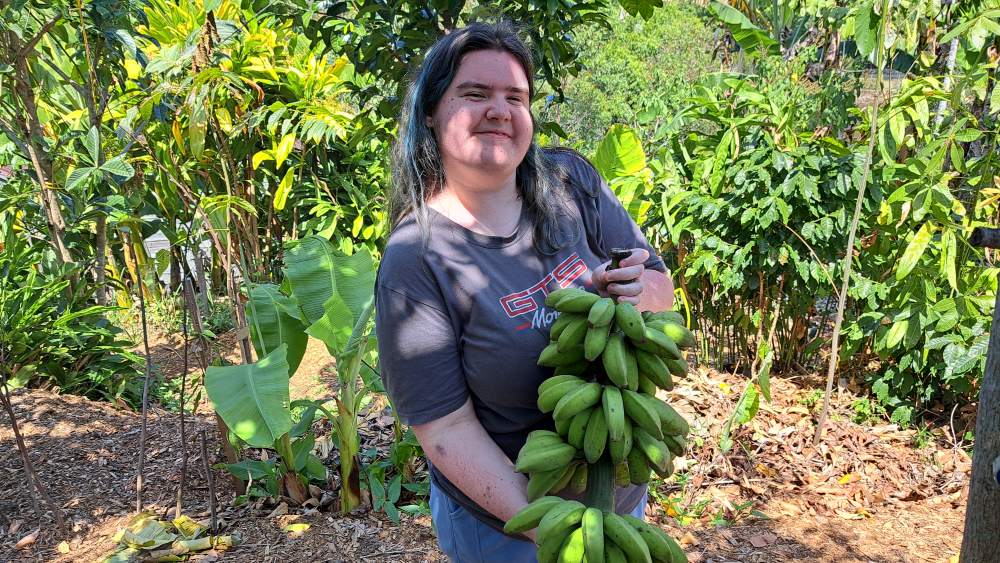
The only harvest recorded from the 90 m² area during September was a young banana bunch.
Birds had begun eating the upper bananas, and the bunch was cut and placed in a dark shed to ripen.
It contained approximately 50 bananas. After two weeks, only six had ripened.
This suggests the bunch may have been harvested before sufficient maturity for satisfactory ripening, although the observation alone does not establish the cause.
The experience prompted a reconsideration of the decision to harvest.
At Ediblescapes Garden, bananas are not grown exclusively for human consumption. The garden does not routinely cover banana bunches with protective bags to exclude birds.
Bird feeding is part of the ecological interactions visible to children, volunteers and other public visitors. Fruit development, wildlife feeding and the relationships between cultivated plants and other living beings are themselves valuable learning experiences.
On another occasion, leaving a similarly immature bunch for the birds may be more consistent with the garden's purpose than harvesting it prematurely.
A banana bunch can offer food for wildlife, opportunities for observation and learning, and a reminder that an edible forest garden is not simply a production system organised around human needs.
Deer Visiting the Living Garden
During September, deer were also observed visiting Ediblescapes Garden, including the 90 m² observation area.
Their browsing was particularly noticeable on the tender upper growth of woody plants, especially hibiscus, which appeared to be a preferred food.
In some cases, deer unintentionally pulled young plants from the soil while feeding. These plants had not yet developed sufficiently established root systems to resist the disturbance.
These encounters introduce another dimension to the garden's relationships with wildlife.
Deer browsing can influence vegetation structure, remove growing tips and affect the development of young trees and shrubs. While established plants may recover from some browsing, newly propagated plants are more vulnerable to being uprooted or repeatedly damaged.
The observation also raises an interesting comparison with selective pruning. Both human cutting and animal browsing can remove growing tips, but they differ in timing, intensity, selectivity and consequences for the plant. Browsing should not automatically be interpreted as beneficial pruning or as a syntropic growth intervention.
As with the birds feeding on bananas, the presence of deer reminds us that the garden is not used exclusively by humans. However, sharing a living environment with wildlife also involves recognising situations where young plants may require protection during establishment.
The September observations invite us to follow how the affected plants respond, whether they recover, and how repeated browsing may influence the garden's developing vegetation structure.
A Garden Observed Rather Than Reshaped
No pruning or mulching took place within the 90 m² observation area during September.
Pruning, mulching and other practical maintenance continued elsewhere in Ediblescapes Garden, but those activities should not be confused with interventions in this particular observation area.
The September record is therefore principally a record of seasonal development: vegetation responding to earlier management, young trees establishing, changing moisture conditions and wildlife interacting with food plants.
The garden was not entirely without human intervention, as weekly watering and the banana harvest occurred. Nevertheless, the absence of new vegetation cutting within the observation area allows us to follow its developing structure before another selective intervention becomes necessary.
The purpose is not to leave the garden unmanaged indefinitely. It is to observe carefully enough that future interventions respond to what the living garden is showing us.
September at a Glance
Reporting period: 1-30 September 2026
Observation area: 90 m²
Season: Early spring
Weather: Alternating warm, dry and cooler conditions; no significant rainfall episode reported
Rainfall: Monthly total not confirmed (14mm)
Watering: Four occasions, alternating central beds and borders
Irrigation duration: Approximately 8–12 hours total
Water volume: Not measured
Harvest: One young banana bunch, approximately 50 bananas; six ripened after two weeks
Pruning and mulching: None within the 90 m² area during September
Regeneration: Volunteer vegetation regrowth, reaching approximately 40 cm in places
Propagation: Previously propagated tree cuttings continuing to establish
Wildlife: Birds feeding on bananas; deer browsing tender woody vegetation, particularly hibiscus, with occasional uprooting of young plants.
Active lenses: Syntropic Practice, Agroecology, Living Biology
Volunteer hours: water system set and take out: 1.2h
Learning to Read the Living Garden
September reminds us that caring for a garden does not always mean intervening in its vegetation.
Sometimes the most important work is to observe what has developed since the last intervention, recognise the relationships taking shape, and consider whether further action is necessary.
The renewed growth of volunteer vegetation raises questions about the timing of cutting, flowering, seed dispersal and the changing light requirements of young trees.
The selective pruning of border trees has already contributed propagation material for another generation of plants. This practical relationship between established vegetation and young growth is part of the garden's developing syntropic structure.
The banana harvest offered a different lesson. By cutting a bunch after birds began feeding, we may have interrupted fruit development too early. Leaving a future bunch for wildlife could provide greater ecological and educational value than attempting to reserve it for human consumption.
And September's watering invites us to look beyond the amount of water entering a hose.
The garden's soil is not an inert container for roots. It is a living environment shaped by physical structure, organic matter, microorganisms, soil animals, roots and the continuous processes of growth and decomposition.
We do not yet know enough about how these relationships influence the garden's water balance, particularly during extended dry periods.
That uncertainty is not a weakness in the Garden Journal. It identifies what we can investigate next.
The observations of September suggest a continuing approach to learning: document what happened, distinguish observation from interpretation, examine the explanations offered by gardening traditions and scientific research, and return to the living garden to see what develops.
We are not only learning how to grow plants. We are learning how to understand, participate in and care for the relationships that make a living garden possible.
September 2026 — A Walk Through the 90 m² Garden
This visual walk-through records the condition of the 90 m² observation garden during September's transition from winter towards summer.
Without spoken narration, the camera invites viewers to observe the vegetation, growing spaces, soil cover and developing structure of the garden.
The accompanying report explores the month's changing weather, supplementary irrigation for young propagated trees, and the emerging questions about soil moisture, ecological resilience and the gradual independence of established vegetation.
Watch the garden. Read the observations. Follow the questions as they develop.
Spontaneous Biomass Supporting the Establishing Garden
By September, the 90 m² garden had developed a dense layer of spontaneous vegetation following the selective cut-and-drop management undertaken in late July and early August.
Fewer than ten dominant types of fast-growing volunteer plants contribute much of this vegetation. Commonly categorised as weeds, they are recognised within the garden for their capacity to generate biomass, maintain living groundcover and contribute organic matter through successive cycles of growth, cutting and decomposition.
Growing among them are young propagated trees and food plants, including moringa, sweet leaf, kutac, kasha, native berries and other species being established within the developing food forest.
The management challenge is not to eliminate spontaneous vegetation, but to maintain a productive relationship between its rapid growth and the needs of the establishing plants.
Selective cutting can reduce excessive competition for light while returning vegetation to the soil surface. At the same time, maintaining living roots and groundcover helps preserve the garden's biological continuity.
Some of these spontaneous plants also have documented culinary and cultural uses. Their potential contribution to shared food preparations can be investigated over time, without making the identification and documentation of every species a requirement of the monthly garden report.
The primary observation is the relationship between spontaneous biomass production, soil care and the establishment of a more diverse, long-lived food forest.
This conversation remains open...
Continue Observing with Us
The September observations leave us with more questions than answers — and that is part of the value of a living garden.
How will the volunteer vegetation respond to its next selective cutting? How will young trees develop through warmer, drier conditions? What can we learn from the interactions of birds, deer and the plants they feed upon? And how does water sustain the living relationships beneath the soil surface?
We invite gardeners, students, researchers and curious visitors to follow these questions through the changing seasons, share their own observations and participate in the continuing learning at Ediblescapes Garden – Country Paradise Parklands, Nerang.
The garden continues growing. Our understanding grows with it.
Continue Exploring Ediblescapes
Follow the Life of the Garden
Each month reveals new relationships between plants, soil, water, wildlife and people. Explore the Ediblescapes Garden Journal to follow the observations, changing seasons and living knowledge developing through our community forest garden.