August 2026
A garden action does not finish when the gardener puts down the tool. Its ecological consequences continue, and observation tells us what response may be required next.
August 2026 Garden Report
Overview
August invited us to look at the 90 m² garden through a different kind of observation.
Rather than asking only how much food was harvested, how much biomass was produced or what gardening work was completed, this month encouraged us to look more closely at the assumptions contained within those questions.
What counts as a harvest? Who is the harvest for? What ecological work is vegetation performing before we cut it? What happens when decomposition, soil building and the next generation of planting occur in the same place?
Two audiovisual observations accompany this month's report. The first follows Javana gardening on 18 August, selectively cutting flowering and seed-bearing plants while speaking about what she is doing. The second is a quiet end-of-month walk through the garden, allowing its density, sounds, vegetation layers and other inhabitants to speak for themselves.
Together, they invite us to encounter the garden not simply as something being managed or measured, but as a living community being continually observed, altered and responded to.
Key observation
A garden action does not finish when the gardener puts down the tool. Its ecological consequences continue, and observation tells us what response may be required next.
What Was Harvested — and Who Was the Harvest For?
Harvest is usually understood as useful food removed from a garden for people.
August complicates that definition.
On 18 August, Javana selectively cut flowering and seed-bearing plants before their seeds matured and dispersed beyond the garden. This is an established Ediblescapes practice for managing self-propagating plants.
The plants were not pulled out. Their roots and below-ground biomass remained within the soil, while the flowering tops were harvested.
But this harvest was not destined for a kitchen.
The cut leaves, stems, flowers and developing seeds remained within the garden. Biomass created through photosynthesis became material available for decomposition, soil organisms and future plant growth.
This asks us to widen an apparently simple Garden Report question:
What did the garden harvest this month — and who received it?
People are one possible recipient of a garden harvest. The living soil and future generations of plants can be others.
VIDEO — Garden Action, 18 August 2026
Javana Gardening and Speaking
While working, Javana explains why the flowering tops are being cut before seed dispersal, why the plants are not being pulled from their roots, and how both above-ground and below-ground biomass continue participating in the garden.
Composting Without Moving the Compost
The harvested material was placed into a new in-situ decomposition area.
This is not a conventional compost heap intended to mature before its finished compost is carried somewhere else.
The place where decomposition happens becomes the place where the next garden grows.
Fresh green material and woody brown biomass are accumulated directly within the future growing area. As the material settles and begins decomposing, approximately 10–20 cm of garden soil can be added over it and propagation material from the existing garden planted into the developing substrate.
Decomposition and cultivation therefore overlap in both space and time.
This is not a new method being introduced to the 90 m² garden. Much of the deep, sponge-like soil now beneath the garden has developed through years of building organic matter in place, planting into it and continuing to add new biological material.
The garden is therefore not simply growing on soil.
The soil itself is one of the things the garden has been growing.
From Biomass to Soil — and Back to Biomass
August makes it difficult to identify a clear beginning and end to the garden's productive cycle.
Plants capture solar energy through photosynthesis and transform atmospheric carbon dioxide and water into organic compounds from which living biomass is constructed.
Some becomes human food.
Some becomes leaves, stems, flowers and seeds.
Some remains underground as roots.
Some is cut and repositioned.
Some feeds decomposers and other organisms.
Some contributes to soil organic matter and structure.
New plants then grow through that developing soil and begin photosynthesising again.
We might represent this simply as:
photosynthesis → biomass → harvest → decomposition → soil building → new growth → photosynthesis
But even this is an approximation. In a living garden, these processes are happening simultaneously.
Carbon is therefore not present only in tall tree trunks and canopy. It is continually moving through leaves, stems, roots, organisms, soil and decomposing organic matter, with different forms remaining in the garden for different periods of time.
Harvesting Water
Water use in the 90 m² garden has another unusual characteristic:
there is no irrigation system, and the garden is normally not watered.
When supplementary water is necessary, it is applied manually. Small areas are watered with 10-litre watering cans, while a hand-held hose can be used when a larger area shows a need.
Over approximately the past four years, supplementary watering has generally been needed on only four to eight days per year, principally during September and October when there has been no rain for more than about two weeks.
This practice is intentional.
Ediblescapes does not routinely irrigate on a schedule. We observe the garden and water where plants show that supplementary moisture is needed.
Established trees and plants are encouraged to develop within the deeper soil profile rather than depending upon frequent watering near the surface. At the same time, the garden continually builds the conditions that help make this possible: deep organic matter, decomposing biomass, roots occupying different depths, multiple canopy layers, shade and protected soil.
Morning moisture
We repeatedly observe another interesting difference within the garden.
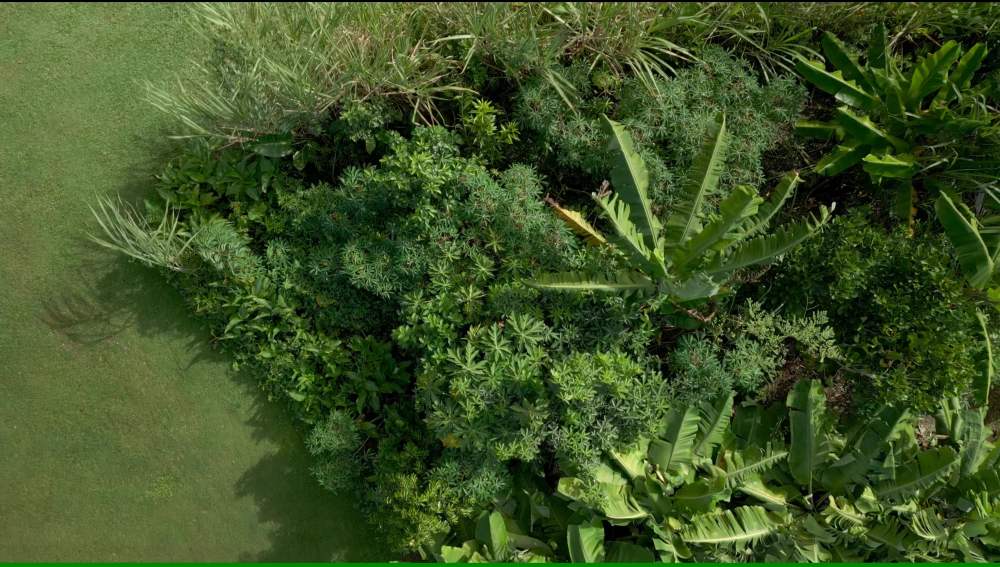
Areas beneath dense and diverse vegetation, with several layers of canopy and abundant green biomass, remain wet for approximately two to three hours longer in the morning than nearby areas with low grass or insufficient vegetation cover.
We do not yet know the relative contribution of each process involved. Shade, reduced wind, slower evaporation, dew or mist interception, vegetation density, soil structure and root systems may all participate.
Rather than assigning the observation prematurely to one mechanism, it gives us something valuable to continue observing:
How does the structure of a garden influence how long it can retain the moisture arriving overnight and during the morning?
When Our Intervention Changes the Water Relationship
The August cutting also changed some of these relationships.
The abundant upper vegetation was not only producing seeds. While standing, it was photosynthesising, shading the soil, slowing air movement, protecting the surface and participating in the humid microclimate of the densely planted garden.
Removing some of that upper biomass therefore changed more than seed production.
At the beginning of September, we can already observe that some of the newly exposed soil is beginning to dry.
Other established areas of Ediblescapes, where abundant vegetation, canopy and surface biomass have not recently been disturbed, continue to cope without supplementary watering.
The developing 90 m² area is presently different for two reasons. Much of its propagation material was established only around two or three months ago, and our August intervention removed some of the upper biomass that had been protecting its soil.
If rain does not arrive during the coming dry conditions, these areas may temporarily require supplementary watering, potentially around once a week where observation indicates a need. Additional mulch will also be returned to the exposed soil.
This is not necessarily a new irrigation regime.
It may instead be a consequence of our own intervention.
When human action temporarily removes an ecological function, responsibility for responding to the resulting condition returns to the gardener.
Cutting creates another obligation.
What Season Is the Garden Experiencing?
According to the conventional Australian four-season calendar, September marks the beginning of spring.
The living conditions experienced in the Gold Coast garden tell a more locally specific story.
Drawing attention to seasonal understandings shared through First Peoples' knowledge of this region reminds us that local ecological seasons do not necessarily correspond neatly with an imported four-season temperate calendar.
By the end of August, rainfall had ceased and the garden was beginning to dry. In the first days of September, the seasonal change became pronounced: inland Nerang moved rapidly towards temperatures around 30°C and above, while the more maritime Gold Coast Seaway remained several degrees cooler.
For the garden, therefore, increasing heat and drying soil are not preparations for a distant summer.
They are conditions to which the garden is already responding.
This gives us another apparently simple question:
What season is it?
Do we answer only from the calendar, or also from what plants, soil, animals, weather and generations of locally accumulated knowledge tell us?
Walking Into the Garden
At the end of August, we recorded a second kind of observation.
There is no explanatory narration.
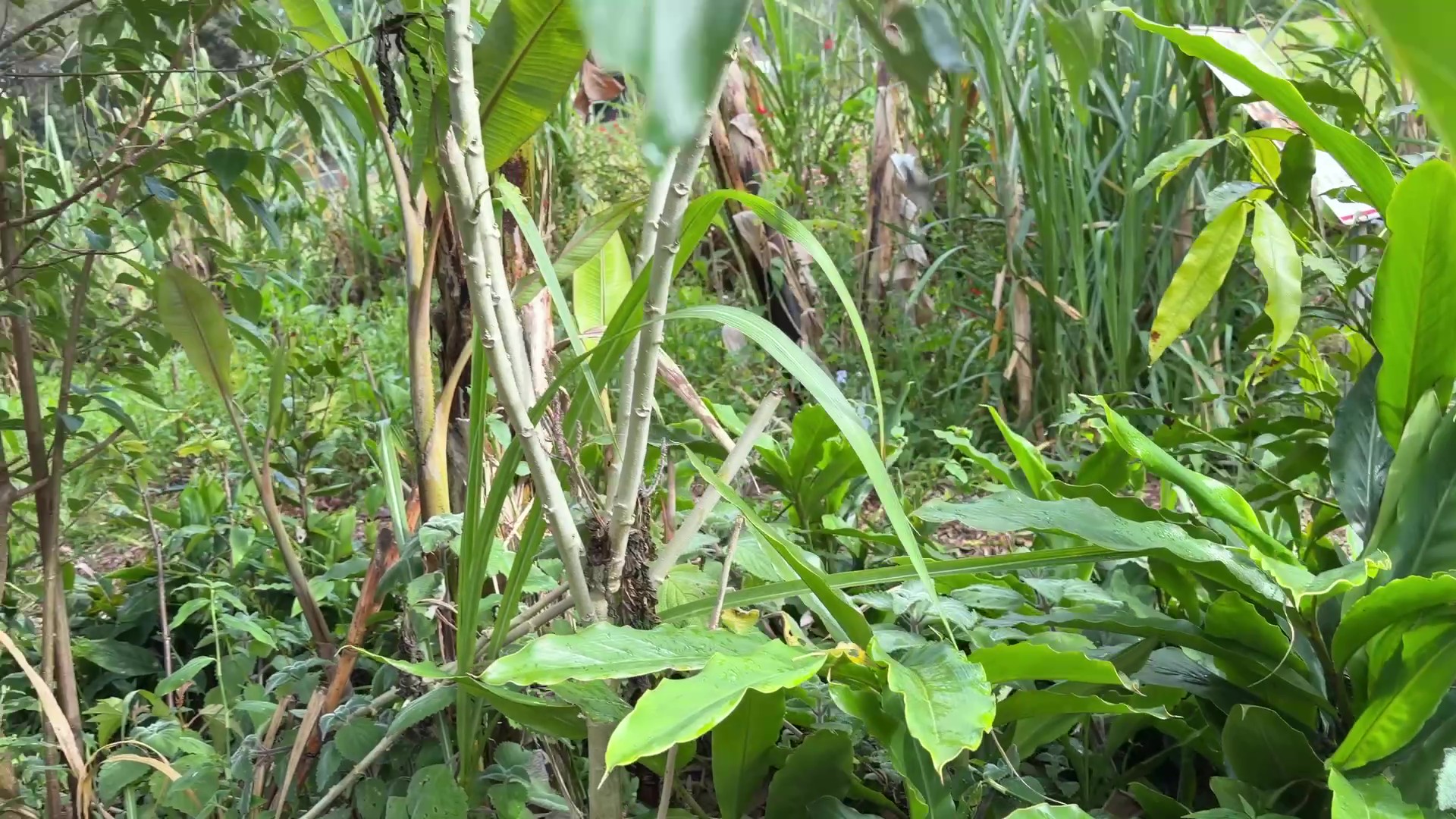
The camera simply walks through the 90 m² garden as it existed at that moment.
VIDEO — End-of-August Garden Observation
The viewer is free to enter without being told exactly what to see.
One person may notice the number of different bird calls.
Another may begin recognising plants.
Another may notice weeds.
Another may see the density of trees and vegetation occupying such a small area.
Someone else may notice shade, canopy levels, fallen material, openings, insects or the relationship between cultivated and self-propagating plants.
The video does not provide the interpretation.
It provides an opportunity to observe.
Gardening as Response
The two August videos offer complementary ways of encountering the garden.
In the first, Javana works, touches, selects, cuts and speaks. Knowledge emerges through participation.
In the second, there is no gardener explaining what should be understood. The garden can be encountered through presence and attention.
One shows participation.
The other invites observation.
Together they reveal a recurring pattern of garden care:
observe → intervene → observe the consequences → respond again
Ediblescapes is not intended to behave as a conventional landscaped garden whose continued existence depends upon constant gardener inputs.
It is being cultivated toward the behaviour of a diverse young forest system increasingly capable of protecting soil, exploring deeper moisture, cycling biomass and participating in its own regeneration.
The gardener remains present, but not as controller of every process.
The questions become:
Where can the garden care for itself?
Where has our intervention temporarily reduced that capacity?
When does care require us to intervene again?
August Reflection — When the Questions Begin to Change
The apparently straightforward questions used to document a garden can contain assumptions of their own.
What was harvested?
Can assume that harvest means food for humans.
How much biomass was produced?
Can count material while overlooking the ecological work that living biomass performs.
How much compost was made?
Can assume compost is a product created in one location and later transported somewhere else.
How much water did the garden use?
Can overlook how vegetation, roots and soil structure participate in receiving, protecting and retaining water.
How much carbon was stored?
Can draw our attention towards trunks and tall canopy while making less visible the continual movement of carbon through leaves, roots, organisms and decomposing organic matter.
What season is it?
Can assume that a four-season calendar describes what a particular living place is actually experiencing.
August does not give us final answers to these questions.
Instead, the garden makes the questions themselves more interesting.
Perhaps this is one purpose of a continuing Garden Report: not simply to accumulate measurements, but to notice when observation of the living garden requires us to reconsider what we thought we were measuring.
The garden is always changing.
Our questions may need to grow with it.
This conversation remains open...
Visit the garden, spend some time observing, and form your own questions. What do you notice when a garden is approached not simply as something to manage, but as a living community to listen and respond to?
Continue Exploring Ediblescapes
What is the garden telling us?
A garden can be read in many ways. Follow the 90 m² Garden Project month by month as we observe how biomass, soil, water, plants, people and other living beings continually reshape their relationships.