MICELIO
Cultivating Creative Biodiversity

MICELIO
Cultivating Creative Biodiversity
An artistic and cultural initiative of Ediblescapes
Micelio is a developing artistic and cultural practice exploring creativity through relationships between people, living systems, materials, knowledge, culture and place.
Inspired by mycelium — the largely unseen networks through which fungi participate in living ecosystems — Micelio approaches creativity in a similar way: as something that can emerge through relationships rather than from a single discipline or individual.
A gardener, artist, craftsperson, scientist, child or cultural knowledge-holder may each perceive something different.
Plants, fungi, animals, materials, weather and time also participate in determining what becomes possible.
Micelio creates conditions for these different ways of making, knowing and living to encounter one another.
Cultivating Creative Biodiversity
Just as biological diversity strengthens living ecosystems, Micelio asks what creative biodiversity might make possible.
Creativity is not understood here as belonging only to professional artists.
It can be cultivated through observing, growing, making, remembering, experimenting, caring and responding.
Micelio cultivates creative biodiversity by creating conditions in which people, cultures, materials and other living beings can participate in making.
Explore Micelio
Evolution
Origen
A Practice Growing from a Living Garden
Micelio has grown from nearly a decade of creative experimentation within Ediblescapes.
The relationship between art and garden was present before the community garden was formally established.
2017 — An artwork that became a garden
The future Ediblescapes garden began as a Geoglyph Earth Art project.
Mulch drew a large-scale artwork across the landscape while trees and plants grew in repurposed denim containers positioned within the design.
The artwork was temporary.
The relationships it initiated were not.
Plants established into the ground, people continued caring for the site, and over subsequent years the artwork became a living edible forest garden.

2019–2020 — Observing life making form
While experimenting with biofermentations for the developing garden, another creative observation emerged.
Microbial communities produced unexpected networks, membranes, colonies and landscapes across the surfaces of the cultures.
These forms were not drawn or sculpted.
Conditions were created in which living organisms could produce them.
This introduced a question that continues within Micelio today: what happens when the artist does not determine the final form, but cultivates conditions from which form can emerge?

2022–2023 — Making living relationships perceptible
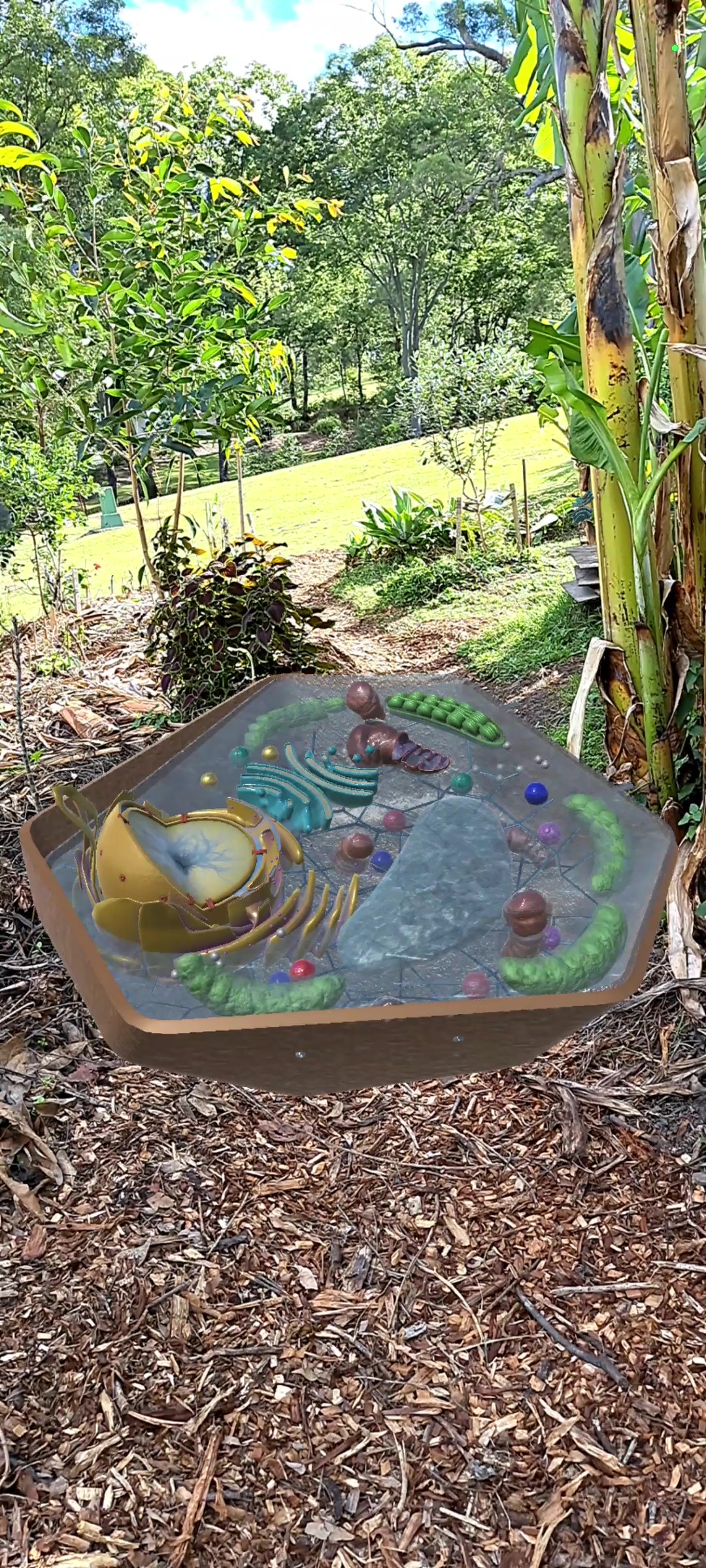
Later experiments with digital modelling and augmented reality explored ways of interpreting relationships within living soil that are difficult to perceive directly.
Digital technologies became another means of looking — not a replacement for the garden, but a way of asking how invisible biological relationships might become perceptible.
These experiments now lead Micelio towards a new question:
What happens when we stop thinking about making an artistic object for a living place, and begin cultivating the living place itself as art?
The artwork is no longer necessarily something completed and subsequently installed.
It may grow.
It may be pruned.
It may produce food.
Branches may be selected, propagated, bent, woven and layered.
Roots may find new ground.
Materials may weather and eventually surrender some of their functions to living growth.
People return, observe and intervene again.
**The artwork is not completed and then maintained.
It continues to be made through care.**
The Artist–Gardener–Agroforester
Cultivating a living place requires continuing human participation.
Trees and perennial plants produce new pulses of growth. The artist–gardener observes these responses and works with them through pruning, propagation, layering, weaving, guiding and harvesting.
The process becomes cyclical:
Observe → Imagine → Guide → Prune → Propagate → Weave → Cultivate → Harvest → Observe Again
The gardener does not completely determine the resulting form.
Neither does the plant.
The work emerges through their continuing relationship.
This means that care is not maintenance performed after the artistic process.
Care is a creative act.
Growing Structures
Micelio is beginning to explore how trees and plants might gradually participate in forming places for human encounter.
The investigation learns from growth behaviours already present within forests and gardens.
Mulberries and some fruit trees respond to pruning by producing vigorous young rods that can be propagated, trained, layered and woven.
Vines can travel rapidly through structures, producing food and seasonal shade.
Large-leaf edible plants can create living overhead surfaces.
Rather than reproducing the appearance of these biological forms synthetically, Micelio asks:
Can their growth behaviours themselves become artistic material?
Floating Ramada — Learning from the Garden
Learning from the Floating Ramada
Before Micelio began developing its plywood framework, another experiment was already taking place within the Ediblescapes gathering space.
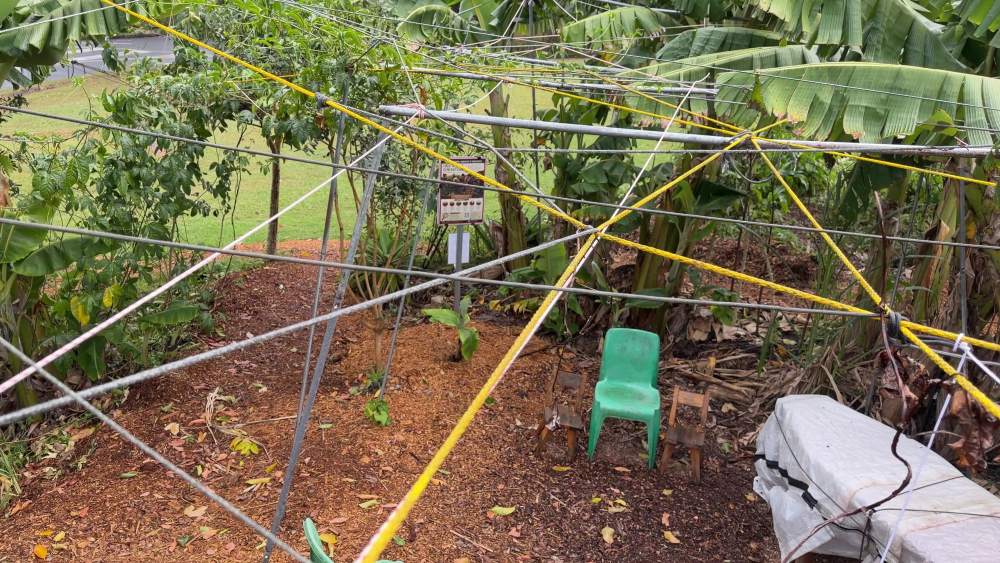
The Floating Ramada was created as a lightweight overhead network of cords, initially supporting climbing plants and beginning to explore a longer-term question: could an elevated guiding network help form the young trees of a future Living Cathedral as their growth reached above approximately two metres?
The intention was not to make the trees support a conventional roof. The ramada was conceived as a formative field — a temporary geometry through which new growth could be selected, guided and cultivated towards an emerging living canopy.
The garden has responded sooner than expected.
The ramada uses different kinds of cord. Thicker yellow plastic ropes are generally connected more loosely between branches rather than tightly encircling the trunks. Brown cords of another material provide greater weather resistance and can carry higher tension.
These differences are useful to the experiment, but they also reveal that material strength alone does not resolve the central problem. A cord may survive outdoors and carry substantial tension while still becoming restrictive if it remains wrapped around living wood that continues to increase in diameter.
The critical relationship is therefore not only material to load, but material to growth.
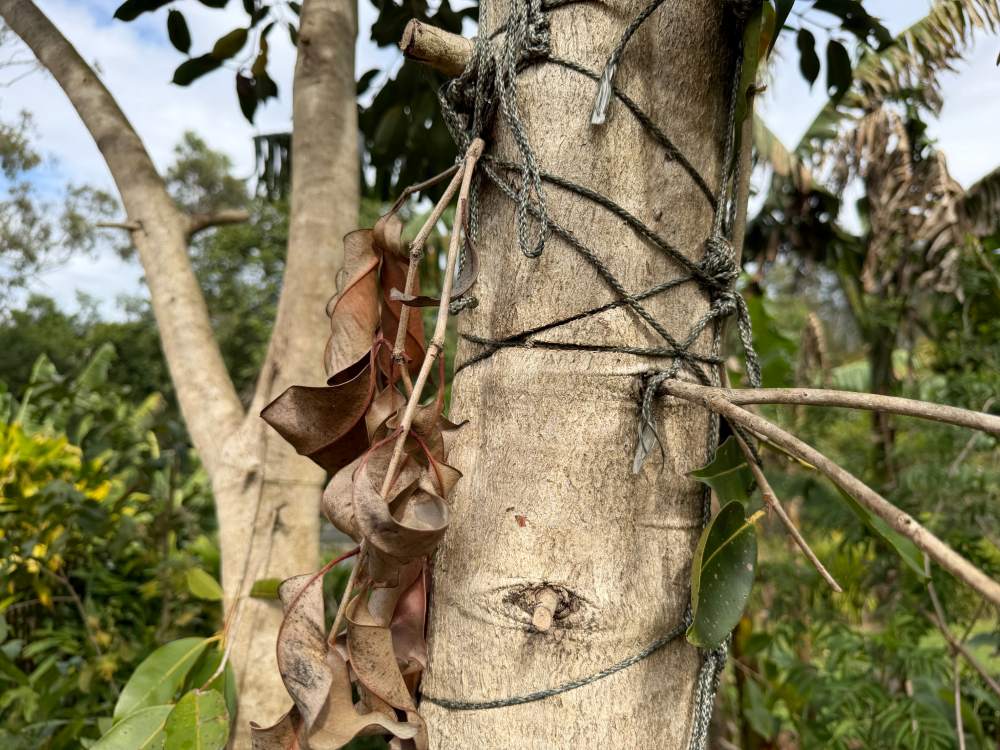
The ramada uses different kinds of cord. Thicker yellow plastic ropes are generally connected more loosely between branches rather than tightly encircling the trunks. Brown cords of another material provide greater weather resistance and can carry higher tension.
These differences are useful to the experiment, but they also reveal that material strength alone does not resolve the central problem. A cord may survive outdoors and carry substantial tension while still becoming restrictive if it remains wrapped around living wood that continues to increase in diameter.
The critical relationship is therefore not only material to load, but material to growth.
These observations have not ended the experiment in forming trees. They have changed its direction.
Micelio is now exploring a framework that can stand independently from the trees while still entering into close conversation with their growth.
The distinction is important.
The tree should not have to support the instrument being used to form it.
Instead, an independently supported framework can provide a stable spatial reference from which young branches, vines and other vegetation can be temporarily guided. As living wood thickens and establishes its direction, ties can be loosened, relocated or removed. Other guiding components may need to open, be cut back or eventually disappear.
The Floating Ramada has therefore become an important precursor to Draft 02.
It demonstrates something central to Micelio’s emerging practice: a living system cannot simply be fitted permanently into a fixed human geometry. The framework itself must be capable of responding to growth.
The experiment does not ask the tree to obey the structure. It asks how the structure can learn when to guide, when to adjust, and when to let go.
Digital Making Meets Living Growth
CAD modelling and digital fabrication provide a human geometry from which the biological process can begin.
Micelio is exploring a modular CNC-cut plywood framework that establishes an independent spatial structure through which ground-rooted vegetation can progressively grow.
It can provide spatial references for guiding selected branches and vines while remaining structurally independent from the trees.
The plywood is not intended to imitate a tree.
It is an instrument for cultivation.
As trees grow, branches thicken, roots establish and vines occupy space, the relationship between designed structure and living structure continually changes.
Some elements may remain.
Others may be replaced.
Others may eventually no longer be necessary.
Human geometry begins the conversation. Living growth continues it.
Draft 02 — Cultivation Framework
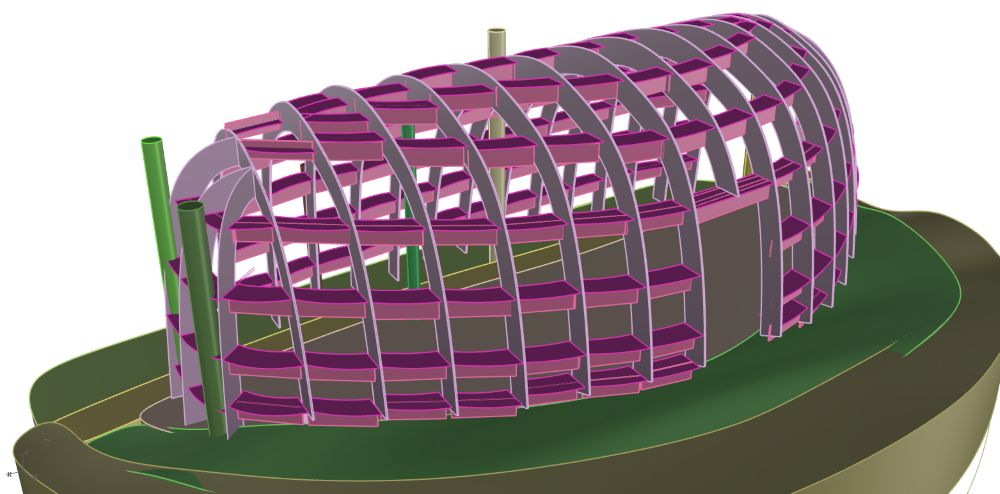
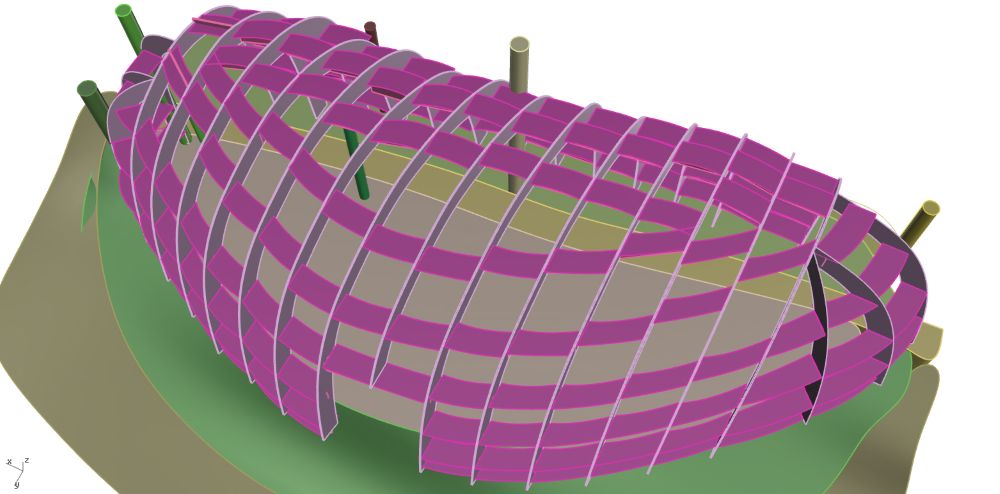
Draft 02 develops the Living Cathedral as a simple, independently supported plywood framework within the existing gathering place.
Repeated transverse frames establish an approximately 800 mm structural rhythm, connected longitudinally to create a three-dimensional framework through which vegetation can grow. The geometry responds to the existing terrain, trees and circulation rather than establishing a finished architectural form that the garden must follow.
The framework is not intended to carry elevated gardens or determine the final form of the trees. Vegetation remains rooted in the ground.
Fast-growing vines such as choko and Ube purple yam can provide seasonal green growth and shade while the longer-lived tree canopy develops. Existing and newly propagated trees can be selectively pruned and formed through the structure over successive growing seasons.
Mulberries provide an additional experimental possibility. Independently rooted trees can produce vigorous young branches that may be guided towards neighbouring branches. Where appropriate, selected secondary branches can be temporarily held together using adjustable and removable ties, allowing approach grafting and potential inosculation to be explored without forcing the principal growing axis of either tree.
Successful living unions may be cultivated further. Where a union does not develop, the branches and trees remain free to continue independently, be redirected, pruned or eventually removed through the normal processes of syntropic succession.
The plywood therefore establishes an initial spatial framework, while the eventual living form remains open to growth, selection, pruning, succession and time.
Access for Care
Cultivation is undertaken periodically from within the relatively level gathering space.
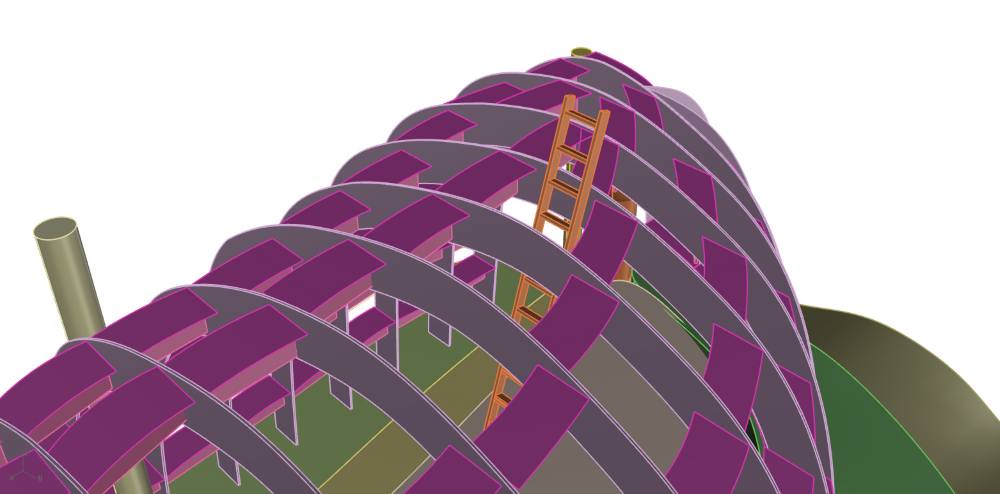
Portable maintenance access can be positioned locally within the approximately 800 mm structural rhythm, allowing selected branches and vines to be reached for pruning, training, tying and observation without turning the plywood framework itself into a permanent climbing system.
The gardener enters when care is required and withdraws when the work is complete.
Prototype 01
Draft 02 is not an image of a finished Living Cathedral. It is the current design proposition from which a first physical prototype can be developed.
Prototype 01 can test a small portion of the framework at full scale: its fabrication and assembly, relationship with the existing place, structural requirements, cultivation access and interaction with ground-rooted vegetation.
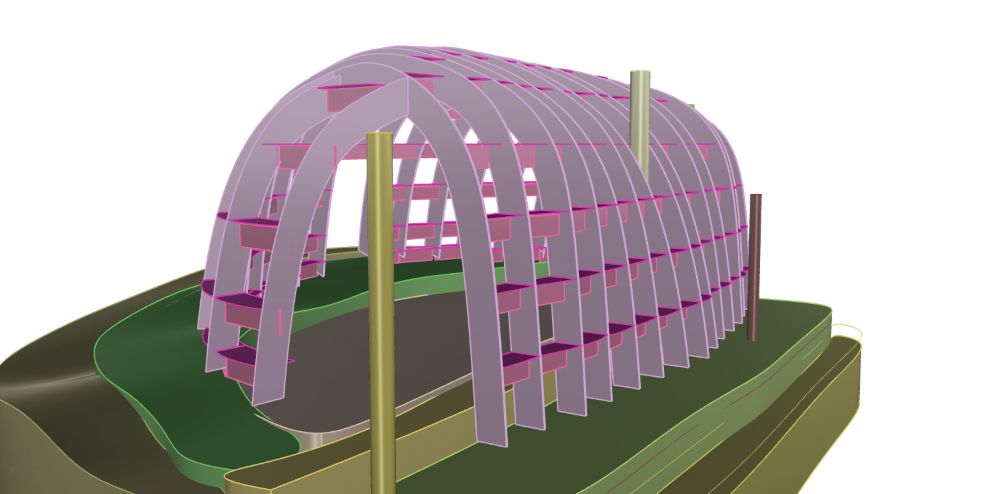
The long-term artwork will not be predetermined by the Rhino model.
The framework establishes conditions.
The gardener cultivates relationships.
The living place develops its own form.
Cultivating the Canopy
An earlier Micelio exploration imagined a fabricated translucent canopy inspired by a giant leaf.
The living garden suggested another possibility:
Rather than manufacture the leaf, cultivate it.
Choko, passionfruit, yams and other edible vines can rapidly colonise an overhead framework.
Large-leaf food plants can contribute living surfaces of shade.
Below them, trees continue being trained and pruned so that light can penetrate where the edible forest garden needs it.
The intention is therefore not to place a garden around an architectural object.
The garden remains the place.
The Place Is Already Growing
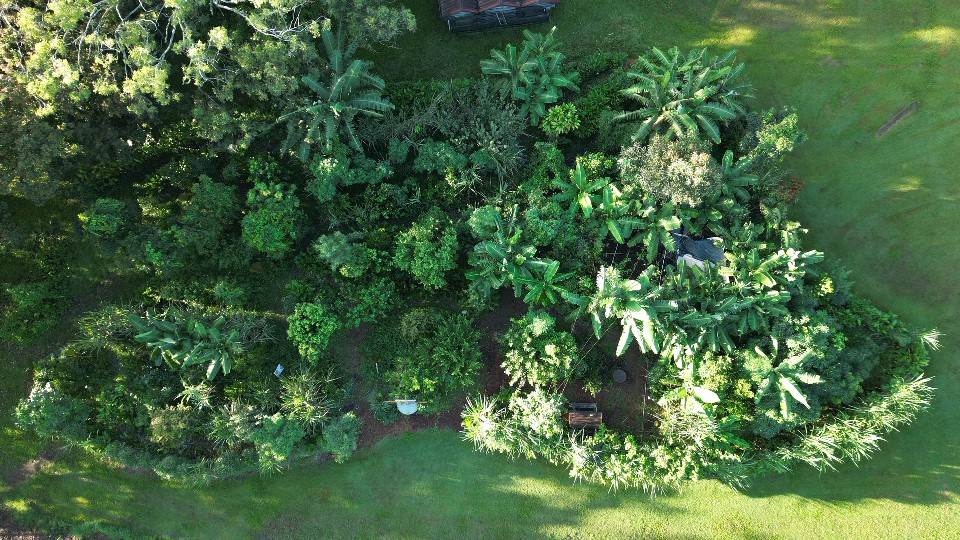
The preferred place for this experiment already exists within Ediblescapes.
It is the gathering area still commonly known as the Banana Circle.
Trees growing around this space were planted as pioneers of an earlier idea we called the Living Cathedral.
We now see those trees differently.
Rather than constructing a new pavilion beside the garden, Micelio proposes to begin by observing what is already alive.
Existing trees, branches, paths, sunlight, garden layers and patterns of human gathering become the starting conditions for creative development.
CAD therefore does not begin with an empty site.
The design begins by listening to a place already growing.
The Banana Circle remains a place for people to meet, talk, learn, taste food, drink tea and spend time within the garden.
The forest garden continues underneath and around it.
What changes is that its future form is intentionally cultivated.

Food, Shade and Encounter
This is not conceived as a restaurant or a conventional building accommodating large numbers of people.
It remains an intimate garden gathering place.
Food-producing plants may simultaneously become part of its spatial formation.
Mulberries can provide fruit and structural growth.
Passionfruit, choko and yams can provide food and canopy.
Other fruit trees continue producing within the surrounding forest garden.
Shade, food, habitat, structure and artistic expression are therefore not separate functions.
They grow together.
Time Is a Creative Material
The work operates across different biological times.
Months — vines colonise structures and create shade.
Years — trees are selected, pruned and formed; neighbouring growth may encounter and sometimes inosculate; the living canopy increasingly occupies the framework.
Decades — trunks, roots and interconnected growth may increasingly define the space.
The work cannot therefore be understood through a single opening day or finished photograph.
Each season becomes another state of the work.
**Time is not what happens to the artwork.
Time is one of its materials.**
If the Place Changes
Ediblescapes is where we hope this exploration can germinate.
Its trees, community history and existing gathering place cannot simply be reproduced somewhere else.
But the creative investigation itself can continue.
If long-term cultivation at Ediblescapes is not possible, Micelio can begin experimental work within an existing small-scale syntropic agroforestry environment as a Living Laboratory.
There, modules, plants and cultivation methods can develop through successive growing seasons.
Through future Open Garden encounters, the experiment could be shared with artists, gardeners, educators and organisations interested in providing another place where the practice could take root.
The intention would not be to reproduce an identical object.
Micelio propagates practices and relationships, not identical structures.
Each place should grow differently.
Cultivating a Living Place as Art
Micelio brings together artistic practice, gardening, agroforestry, digital fabrication, cultural knowledge and long-term care.
It does not seek to make nature imitate a predetermined artwork.
Nor does it imagine that living systems should simply be left to determine everything themselves.
It explores the creative territory between these positions:
human intention and biological agency,
design and emergence,
cultivation and spontaneity,
food and art,
making and caring.
And perhaps, over many years, a place emerges that no person — and no tree — could have made alone.
The artwork is not completed and then maintained.
It continues to be made through care.
Evolution
Micelio
Cultivating Creative Biodiversity
From Drawing to Cultivation — Concept Draft 01
Concept Draft 01 — September 2026
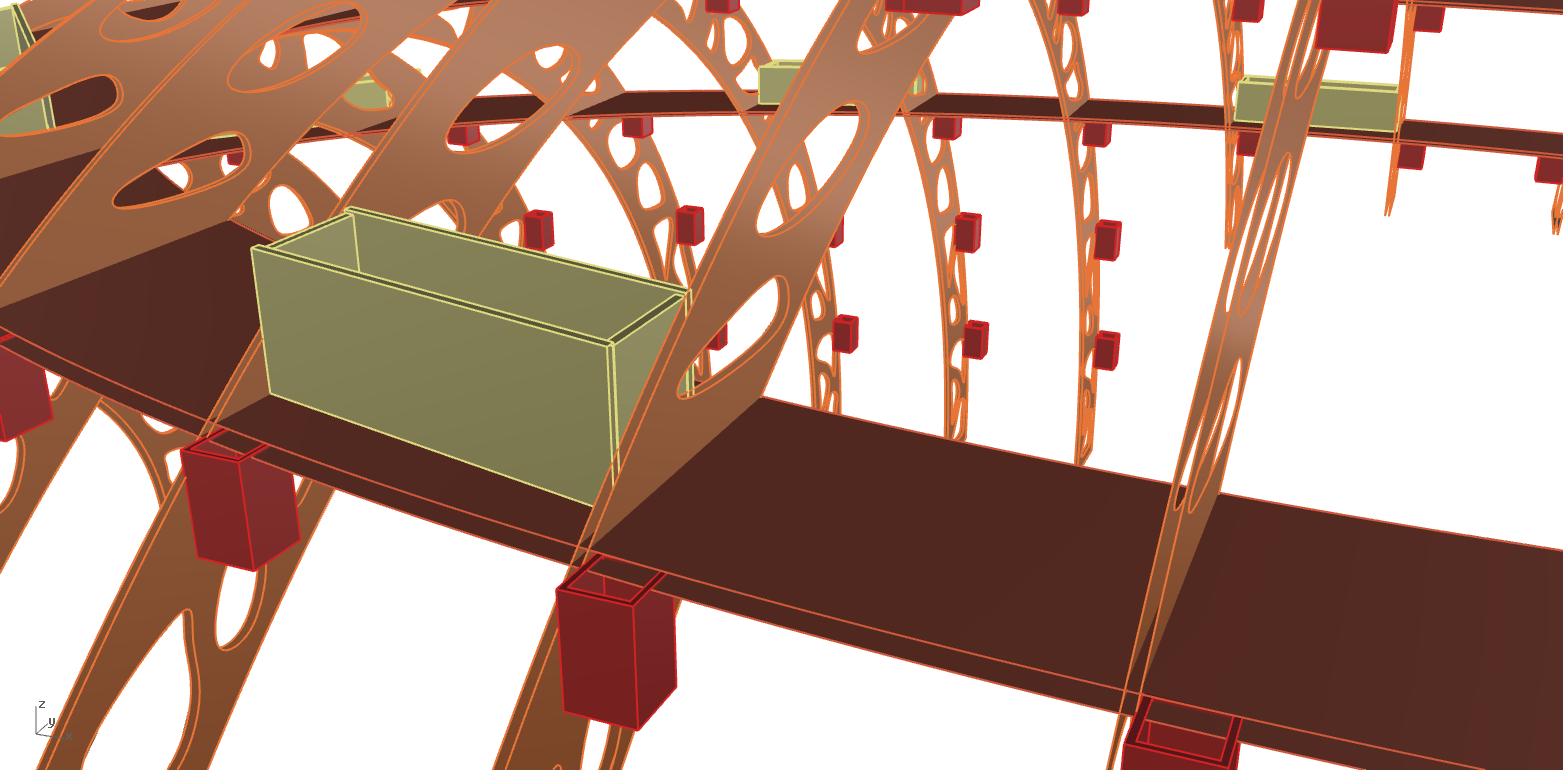
The first Rhino model began by asking how a digitally fabricated plywood framework might create the initial spatial conditions for living growth.
It was deliberately exploratory. The model helped us see the framework not as the artwork itself, but as a temporary instrument through which plants could be guided, cultivated and progressively allowed to transform the space.
Looking critically at this first model changed the project. The next iteration began not from an abstract pavilion form, but from the actual topography, existing trees, paths, vegetation and patterns of gathering within Ediblescapes.
Prototype 01 — beginning without waiting for a finished answer
Micelio and Ediblescapes are prepared to contribute an initial AUD $2,500 from our own resources towards developing a small Prototype 01.
We do not need an arts grant in order for the artistic practice to begin.
The next step, however, is not immediate construction at Country Paradise Parklands.
While the future of Ediblescapes at the parklands is being clarified, we can continue developing Draft 02, documenting the existing living place and refining the relationship between fabrication and cultivation.
If Ediblescapes is able to continue caring for the garden, the concept can then enter a different stage: establishing with the City what structural engineering, construction information, landholder approvals and other requirements would be necessary before any prototype is installed.
Crowdfunding may later allow the community to participate in growing subsequent stages, while the experience and documentation generated by Prototype 01 could support future arts, environmental, educational or community infrastructure funding.
The model is not predicting the finished artwork
Draft 02 will not attempt to show exactly what this place will look like in twenty years.
It cannot.
Trees will respond differently. Some proposed relationships will work and others will fail. Storms, pruning, seasons, gardeners, visitors and ecological succession will participate in making the work.
Rhino gives us a way to propose, test and document relationships.
The garden gives us the response.
The model can then change again.
In this sense, Draft 01 is not replaced by Draft 02. It remains part of the record of how the work is thinking and growing.
There may later be Draft 03, Prototype 01, Growing Season 01 and new digital models responding to what actually happened.
The artwork is not completed and then maintained. It continues to be made through care.
Draft 02 — currently being cultivated.
The next Rhino model will emerge from these observations.