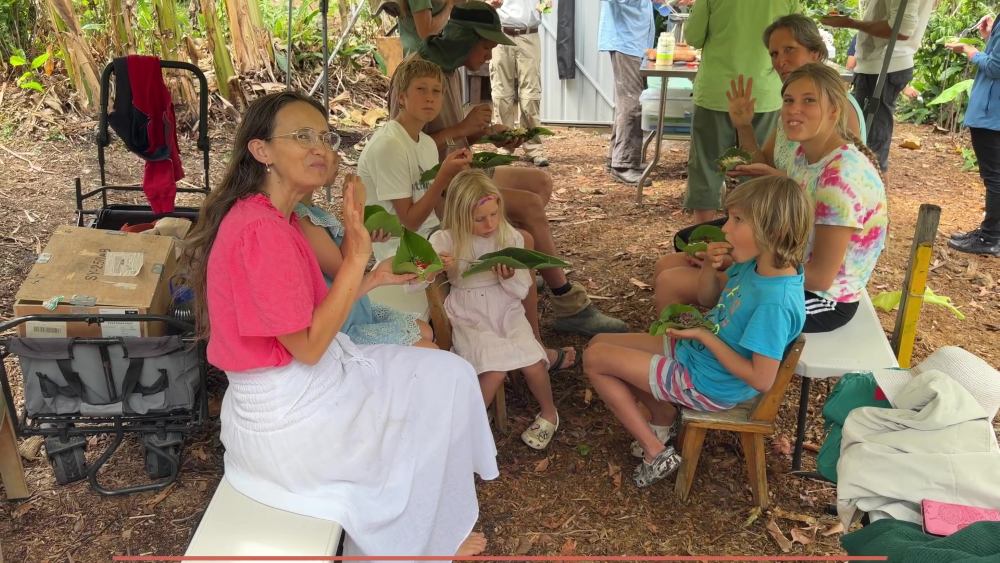
September 2026 Biocultural Gathering
The September Community Biocultural Food Gathering brought people together in the living garden to harvest, prepare, taste and share food while exchanging cultural knowledge, observations and questions.

A gathering in the living garden
On Saturday 26 September 2026, Ediblescapes held its September Community Biocultural Food Gathering at Ediblescapes Garden -Country Paradise Parklands, Nerang.
The gathering continued an evolving practice at Ediblescapes: coming together around plants and food not simply to consume what the garden produces, but to explore the relationships, knowledge, memories and cultural practices that food carries.
Participants moved between harvesting, observation, conversation, preparation, cooking and tasting. Plants growing in the garden became starting points for exchanging knowledge and experimenting together.
Exploring food through practice
The gathering provided an opportunity to continue exploring plants that had been attracting attention in the garden and through recent research, including Commelina, Chaya and the young shoots of choko.
Rather than approaching these plants only as botanical specimens, the gathering asked practical questions: What parts can be eaten? How have different cultures prepared them? What knowledge is needed to prepare them safely? What flavours, textures and combinations emerge when we work with what the garden is producing now?
In this way, harvesting and cooking became forms of inquiry. Knowledge was not separated from practice: it developed through observing, preparing, tasting, discussing and comparing experiences.
Who is the harvest for?
One of the conversations emerging through the gathering asked a deceptively simple question:
Who is the harvest for?
The answer extends beyond the people gathering food for themselves. A living garden also produces for birds, bees and other pollinators, for people who may be hungry, for community, and for generations still to come.
This opens a wider understanding of harvest. The garden can nourish physical needs, but also emotional, cultural, mental and spiritual relationships. What is grown and cared for in the present can simultaneously honour knowledge from the past and contribute something to the future.
Introducing the Commons-Based Community Garden Lens
The September gathering also marked the introduction of the Commons-Based Community Garden Lens within the Ediblescapes Learning Network.
Across the garden, twelve interpretive stations opened different conversations about what it means to grow and care for a living place in common.
The questions included:
- Who harvests from a garden?
- Where does the garden really end?
- Who creates the garden — gardeners, plants, birds, fungi, weather, seeds and visitors?
- How does food carry culture and memory?
- How do we care for public land together?
- How long does it take to grow not only plants, but a culture of care?
The stations were not intended to provide final answers. They invited visitors to observe the living garden and contribute their own experience and interpretation.
From gathering to living knowledge
The gathering does not finish when the cooking, eating and conversation end.
Questions raised around plants such as Commelina, Chaya and choko can continue through the Living Food Knowledge section of the Garden Journal, where research, observations, recipes, cultural practices and future experiments can accumulate.
In this way, the Biocultural Gathering records what happened together, while Living Food Knowledge can follow what we continue to learn from it.
This conversation remains open...
The conversation continues
Biocultural food knowledge grows through practice, memory, experimentation and exchange. If a plant, preparation, story or question from this gathering connects with knowledge you carry, we invite you to continue the conversation with Ediblescapes.
The living garden is always speaking. We learn by listening — and by listening to one another.
Continue Exploring Ediblescapes
Join the Living Conversation
Ediblescapes grows through participation, shared knowledge and care. Visit the living garden, join a future Biocultural Food Gathering, or bring your own food knowledge, questions and experience into the conversation.