
Regenerating Our Relationships with Nature
What does it mean to regenerate our relationships with nature? Drawing on conservation debates, community knowledge and the living experience of Ediblescapes Garden, this reflection explores ecological responsibility, cultural relationships, food and community participation.
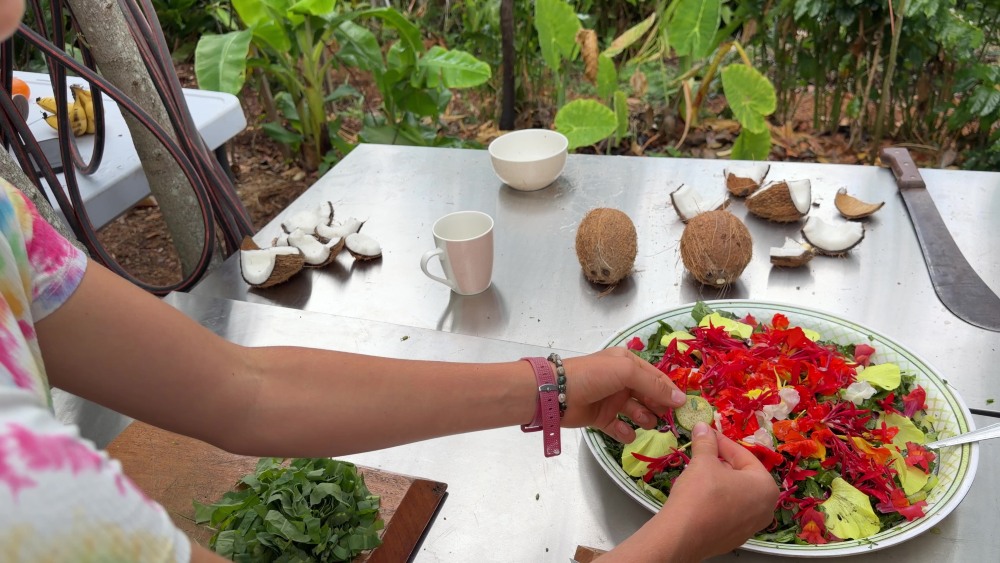
A Dialogue Between Knowledge, Ecology and Community
A reflection from Ediblescapes Garden — Gold Coast, Australia
A recent article, “Cuando proteger la naturaleza cambia las reglas para quienes la habitan”, discussing research on conservation and territorial governance in Mexico's Lacandon Forest, invites us to reconsider a fundamental question: when we protect nature, what relationships with nature are we protecting, transforming or excluding?
The article examines how environmental conservation, despite its ecological intentions, can also reorganise access to land, resources and decision-making. It introduces the concept of green grabbing and describes how Indigenous communities have responded not by rejecting conservation, but by developing their own territorial Plan de Vida, grounded in their knowledge, histories, cultural relationships and collective aspirations.
This perspective resonates with a thoughtful comment shared by a friend in response to our earlier reflection, Permaculture, Spiritual Beliefs and the Politics of Regeneration:
“We must also be critical of what ecological restoration may perpetuate; ideas of purity and ecological function can often exclude people from meaningful relationships with the land.”
Our friend also questioned the historical imagination behind fortress conservation: the aspiration to return landscapes to an ecological condition imagined without people.
These observations invite us to examine not only the ecological objectives of regeneration, but also the histories, cultural assumptions and institutional relationships through which regeneration is understood and practised.
They also remind us that ecological improvement, community participation and the fair distribution of decision-making responsibilities are related but different outcomes. Progress in one does not automatically guarantee progress in the others.
Perhaps regenerating our relationships with nature begins by learning to recognise these differences without losing sight of their connections.
The colonial imagination of nature
In Australia, this question carries particular historical significance.
For tens of thousands of years before European colonisation, Aboriginal peoples inhabited, knew, cared for and managed diverse landscapes through cultural practices, ecological knowledge, food systems and relationships with Country.
British colonisation introduced different systems of territorial ownership, agricultural production, resource extraction and environmental administration. Indigenous relationships with Country were frequently disregarded or denied recognition within colonial institutions.
The transformation was therefore not only ecological and economic. It also concerned whose knowledge, practices and relationships with land were recognised as legitimate.
Today, ecological restoration often seeks to recover native vegetation communities and environmental processes disrupted by colonisation and subsequent development. These objectives can be essential for biodiversity conservation.
Yet the historical reference to a pre-colonial landscape raises another question: can we imagine the ecological conditions of a landscape without also recognising the people and cultural practices that participated in its history?
Recognising these relationships also requires recognising the continuing authority of Aboriginal and Torres Strait Islander peoples in matters concerning their cultural knowledge, responsibilities and connections to Country.
Acknowledgement is important, but it is not equivalent to an authorised relationship of collaboration or the right to interpret and use knowledge belonging to others.
This does not mean that all human interventions are ecologically beneficial, or that food production should occur in every natural area. Nor does it diminish the importance of conserving remnant native ecosystems.
It means that ecological history cannot be fully understood by separating nature from the people who have lived in relationship with it.
Public green spaces: access, participation and belonging
In contemporary Gold Coast, the landscape has been extensively reorganised through private property, urban development, agricultural industries, protected natural areas and publicly administered green spaces.
Community participation in ecological regeneration is often encouraged through tree planting, weed management and other volunteer activities.
These activities make valuable contributions. Yet they also invite us to ask how far community participation extends.
Are communities primarily invited to assist with ecological objectives already defined by institutions? Or can they also contribute to defining those objectives, developing practices, sharing knowledge and participating in the ongoing care of places?
There is a difference between being invited to plant a tree and being able to develop a continuing relationship of responsibility, learning and care with the landscape in which that tree grows.
There is also a difference between public access and the collective capacity to cultivate, harvest, share food and participate in ecological governance.
Access, participation, interpretation and decision-making are connected, but they are not interchangeable. People may be invited to contribute their labour without influencing decisions. They may share knowledge without having an opportunity to question how that knowledge is subsequently interpreted.
At the same time, public spaces belong to a wider community. A community gardening initiative should not make people feel that they must volunteer, participate in organised activities or share a particular ecological philosophy simply to enjoy a public place.
Different participants and institutions also carry different responsibilities. Community involvement does not eliminate the conservation obligations, cultural rights or legal responsibilities associated with public land.
The challenge is therefore not simply to increase participation, but to develop relationships in which contributions are meaningful, responsibilities are understood and different ways of engaging with a place can coexist.
The continuing expansion of urban development raises another question: how do we reconcile the restoration of selected green spaces with the transformation of other ecosystems for residential, commercial and industrial purposes?
These questions do not diminish the importance of native vegetation restoration. They ask whether urban ecological regeneration could recognise a wider diversity of responsible community relationships with land.
Ediblescapes: learning through the practice of a living garden
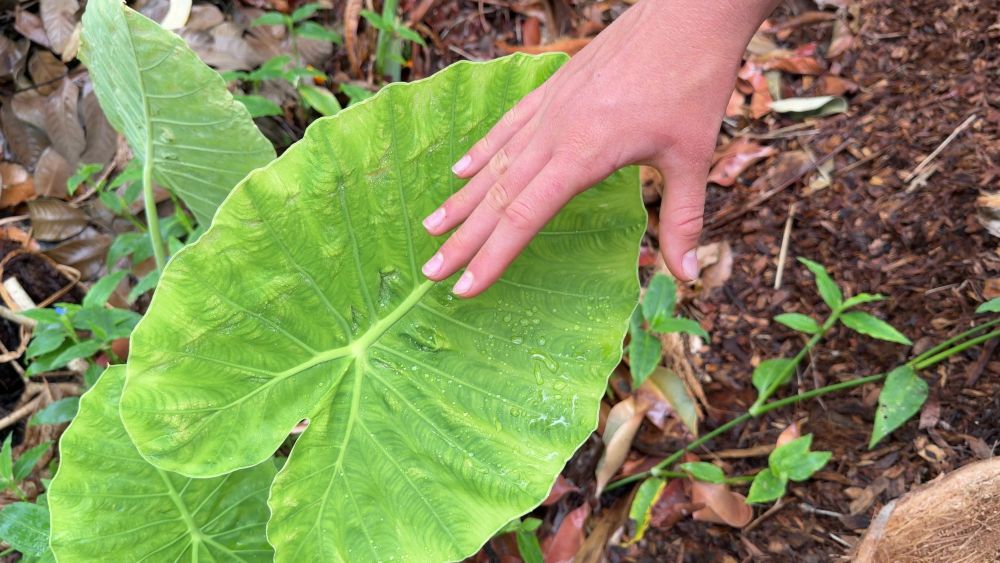
Ediblescapes Garden is a relatively small community edible forest garden, developed since 2017 at Country Paradise Parklands in Nerang, Gold Coast, on Kombumerri Country.
Across approximately 1,000 square metres, we have explored connections among permaculture, natural gardening, agroecology, edible forest gardening, biointensive cultivation and syntropic agroforestry.
Our garden is not an attempt to reconstruct an original forest ecosystem.
Nor do we consider agroecology a replacement for the conservation of native forests, wetlands or other ecological communities.
Rather, we are exploring whether food production can become part of ecological regeneration, and whether forest-like ecological relationships can become part of community food production.
We learn through planting, pruning, observing succession, managing spontaneous vegetation, returning biomass to the soil, harvesting edible plants, preparing food and sharing experiences.
For example, when managing spontaneous vegetation, we may cut selected plants while retaining their roots and returning above-ground biomass to the garden. This approach invites us to observe what happens to soil cover, regrowth, neighbouring plants and the gradual transformation of organic materials.
But the practice also raises questions. Which plants are being favoured? Which are being suppressed? Could some species spread beyond the garden? How might our decisions affect insects, fungi, birds and other organisms whose ecological relationships extend beyond our food-producing interests?
Similarly, pruning can provide materials for soil cover while influencing light, growth and the succession of neighbouring vegetation. Harvesting edible leaves creates food opportunities, but also removes biomass that might otherwise remain within the garden's nutrient cycles.
These relationships cannot be understood solely through our intentions.
They require observation, ecological responsibility and a willingness to reconsider practices when their consequences differ from what we expected.
Not every practice produces the results we anticipate. Some observations challenge our assumptions. Others invite further experimentation or the reconsideration of earlier decisions.
This is part of the learning process.
Our developing Garden Journal provides a way to document that process through time. From the garden's beginnings in 2017 to more recent observations in the 90 m² Garden Project, it can preserve not only what we have done, but also what we have questioned, changed and learned.
The different approaches explored over the years are part of this history. We do not need to present every earlier practice as an inevitable step towards our current understanding.
Nor should we confuse an observed condition with a demonstrated ecological improvement. Returning biomass to the soil, for example, does not by itself establish a measured increase in soil carbon.
The garden is not simply a place where previously established knowledge is applied. It is also a place where knowledge emerges through continuing relationships among plants, soil, climate, people and ecological processes.
These experiences do not replace scientific research or Indigenous ecological knowledge. They contribute another situated source of learning, open to dialogue, critical examination and revision.
Who has the authority to produce ecological knowledge?
The discussion about conservation also raises a question about knowledge itself.
Must a community's ecological experience become the subject of an academic investigation before its observations and questions are recognised as meaningful?
We do not believe so.
Community gardeners, farmers, Indigenous knowledge holders, researchers and other practitioners can all contribute to ecological understanding, although their knowledge traditions, responsibilities and forms of evidence are not identical.
Academic research can provide important methods, critical perspectives and analytical capacities. But community experience should not be reduced to material collected for publications whose questions and conclusions are determined elsewhere.
A meaningful relationship between academic and community knowledge requires reciprocity.
It should recognise that communities already have histories of observation, experimentation and interpretation, and that they may continue learning long after a formal research project has ended.
At the same time, the legitimacy of community inquiry does not mean that every conclusion drawn from experience is necessarily reliable.
Different questions require different forms of evidence.
An observation about plant regrowth may be explored through repeated garden records. Understanding the cultural meaning of a food practice may require listening to people who carry that knowledge. Establishing whether a botanical preparation is safe for consumption may require specialised scientific investigation.
These forms of learning can contribute to one another without becoming interchangeable.
For Ediblescapes, the time of learning is the time of the living garden.
It follows seasons, plant succession, changing conditions, community participation and the questions that arise through everyday practice.
Our Interpretive Lenses are part of this learning relationship.
They invite visitors and gardeners to consider the same living place through different perspectives: ecological succession, soil relationships, food biodiversity, cultural knowledge, community cooperation and other ways of understanding what is happening around us.
But interpretation is never entirely neutral.
When we describe spontaneous vegetation as a resource for biomass, a potential food, a habitat or a biosecurity concern, we direct attention towards different relationships and possible management decisions.
These interpretations may complement one another. Sometimes they may disagree.
The purpose of the lenses is therefore not to impose one explanation, nor to suggest that all explanations have equal evidentiary support. It is to encourage informed observation, conversation and critical inquiry.
This also brings responsibilities towards people who contribute their experiences and knowledge.
A person's original testimony should not be confused with our interpretation of it. Recording a conversation does not automatically give us permission to publish, reinterpret or reuse everything that was shared.
Through Living Conversations, community gatherings and the Garden Journal, we hope to develop practices in which observations can be questioned, interpretations reconsidered and knowledge shared with appropriate recognition and care.
We do not need to resolve every question before continuing to care for the garden.
The living garden is always speaking. The interpretive lenses help us listen.
From the garden to Infusiones: extending the dialogue
Our emerging initiative, Infusiones — Community Biocultural Extension, grows from this same practice of learning through ecological and community relationships.
As Ediblescapes Garden has developed, we have become increasingly interested in the diversity of edible leaves, flowers and other botanical materials that may contribute to everyday food cultures.
This interest opens new questions.
What do different communities know about preparing and consuming botanical infusions?
What cultural traditions accompany these practices?
How can we identify plants responsibly, investigate their composition, understand food safety and distinguish established knowledge from uses that still require verification?
How might the cultivation and harvesting of suitable leaves and flowers contribute to responsible successional management of food-producing trees?
And how could these practices strengthen community food knowledge, local productive capacity and food sovereignty?
These questions connect cultural learning with another practical field of experimentation: the possibility of producing suitable botanical materials through community agroforestry.
At Ediblescapes Garden, our developing interest in biointensive edible-leaf cultivation within syntropic arrangements provides a starting point.
However, productive harvesting also creates ecological responsibilities.
How much leaf material can responsibly leave a garden while maintaining plant health, soil protection, nutrient cycling and the living relationships that support future production?
This question becomes especially important if a community initiative eventually develops beyond occasional educational gatherings.
We do not approach Infusiones with the intention of deciding which infusions people should consume or prescribing solutions for their health.
Rather, we seek to bring together botanical diversity, cultural experience, scientific knowledge and transparent information so that people can make informed decisions according to their own circumstances.
Not every traditionally used plant is necessarily safe as a beverage, and not every potential benefit is scientifically established. Botanical identification, food safety, responsible preparation and applicable food requirements remain essential.
The exploration of a plant's cultural history or potential food use does not automatically establish that it is suitable for serving or distribution.
Infusiones is therefore not simply the development of a new botanical drink.
It is an invitation to extend the dialogue between different forms of knowledge through the everyday practices of growing, harvesting, preparing, sharing and learning.
Through community gatherings, conversations and biocultural extension activities, we hope to learn with people whose food traditions, experiences and questions may be different from our own.
In time, these relationships may also support a wider network of household gardens, community gardens and other agroecological initiatives interested in cultivating suitable plants and exchanging knowledge through a Community Support Enterprises (CSE) Garden Network.
Such a network could explore how small productive spaces contribute to local food capabilities and wider agroecological transitions.
It would also need to consider how the value created through production and exchange can return to the living gardens, the people and the community relationships that sustain it.
This possibility remains exploratory. Its development will depend on ecological suitability, community participation, food safety, institutional responsibilities, fair recognition of work and the capacities we can build together.
Regeneration as a continuing relationship
Returning to the original question about conservation, we recognise that ecological regeneration involves more than restoring vegetation or recovering selected environmental functions.
It also invites us to reconsider the relationships through which people understand, care for and participate in living landscapes.
The conservation of native ecosystems remains essential. So does recognising the distinct rights, histories and responsibilities of Aboriginal and Torres Strait Islander peoples in relation to Country.
At the same time, urban communities can explore additional forms of ecological responsibility in suitable places, including community agroforestry, food biodiversity, soil regeneration and collective learning.
These different contributions should not be treated as equivalent, nor should one be expected to replace another.
Ediblescapes Garden is a small and unfinished experiment within this larger conversation.
We do not claim to have developed a universal model or to possess answers that other communities should adopt.
What we have developed is a practice of asking questions through the experience of caring for a living garden.
That practice also asks something of us: to examine the consequences of our interventions, to recognise the limits of our knowledge and to remain willing to change our understanding when new observations or other perspectives challenge it.
Our emerging Infusiones initiative extends that practice beyond the garden, inviting other communities, cultural traditions and fields of knowledge into the conversation.
Perhaps this is one way to respond to the concern expressed by our friend: that ecological restoration should not remove people from the picture of biodiversity.
Rather than imagining regeneration as a return to a landscape without people, we can explore how to regenerate our relationships with living landscapes — through ecological responsibility, food cultures, shared knowledge and community cooperation.
And perhaps the question is not only what kind of nature we want to conserve, but also:
What kinds of relationships with nature are we willing to cultivate, learn from and sustain together?
Ediblescapes Garden — Country Paradise Parklands, Nerang, Gold Coast, Australia
Community reflection, November 2026
Reflection informed by
- Chadwick, A., McClure, J., Vallejo Reyna, A. & Velasco, F. (2026). Constitutionalising Resistance? The ‘Plan De Vida’, Bienes Comunales, and the Long History of Green Grabbing in the Lacandon. Law and Critique.
- Fairhead, J., Leach, M. & Scoones, I. (2012). Green Grabbing: A New Appropriation of Nature? The Journal of Peasant Studies.
- A community response to Ediblescapes' earlier reflection, Permaculture, Spiritual Beliefs and the Politics of Regeneration.
- Continuing observations, conversations and practices at Ediblescapes Garden.
- Ediblescapes — Cross-Project Dialogue: Second Consolidated Reflection (5 November 2026), developed through two rounds of reciprocal reflection across eleven Ediblescapes-related ChatGPT projects. A provisional working document, not an adopted organisational position of Ediblescapes Inc.